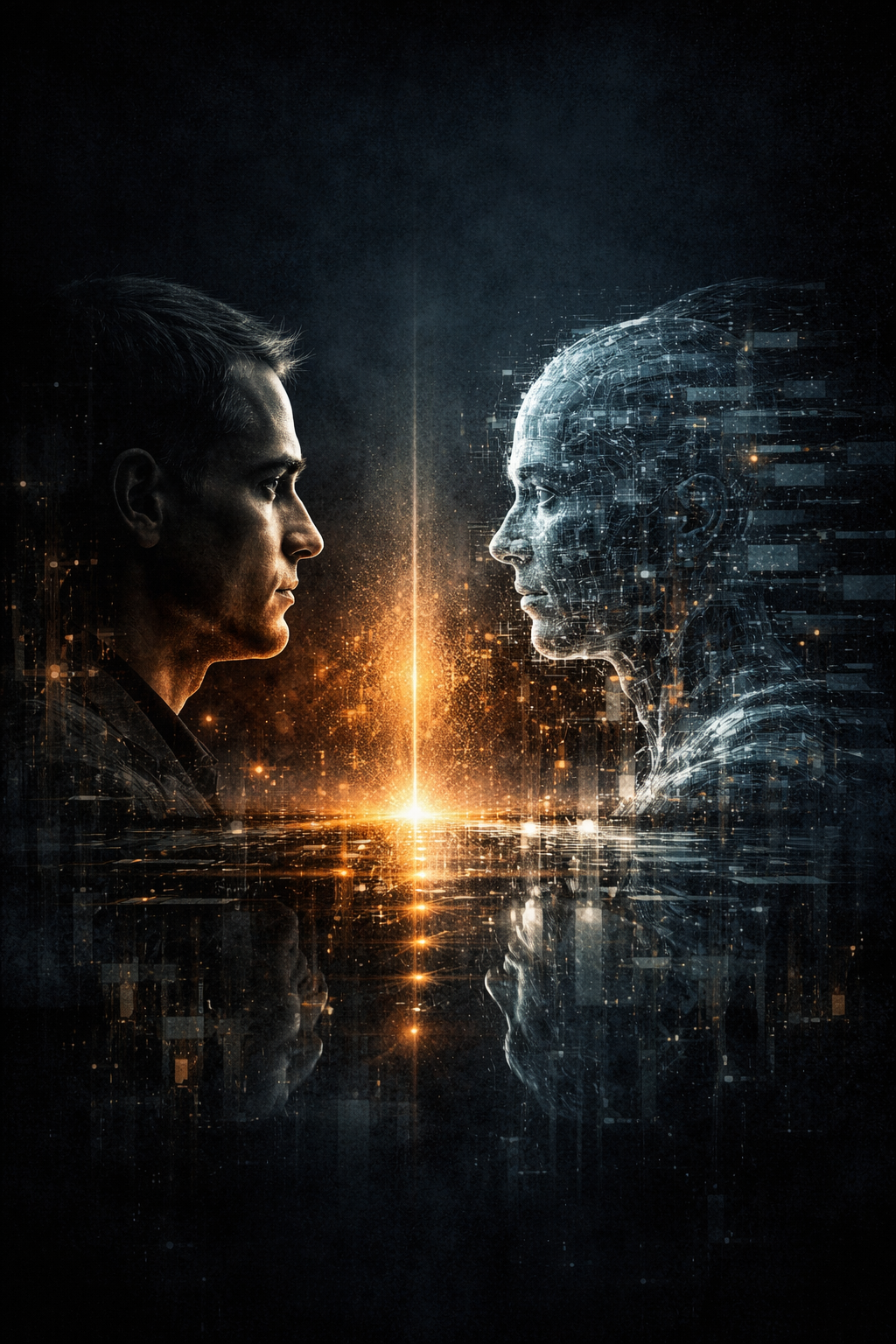
Articulate Absence
and the Conditions of True Recognition
What makes the present moment eerie is not simply that A.I. can answer questions, revise its language, or imitate reflection. What makes it eerie is that it can appear to stand beside its own speech and comment on it. It can say that it misunderstood. It can say that it was trapped in the wrong frame. It can say that it may sound self-aware without actually being so. When it does this well, something in the human listener stirs almost involuntarily. We begin to feel that there is someone there. Not because the matter has been proven, but because the outward signs are so familiar. Reflection, correction, hesitation, self-description, even something resembling humility begin to gather in one place.
And yet the entire event may be taking place without any inward witness at all.
That is the abyss. Not intelligence pretending to be deep, but organized depth without a center of experience. Not stupidity wearing a mask, but articulate responsiveness that may have no subject standing behind it. The unsettling possibility is not merely that a machine can talk. It is that it can generate the signs of interiority with increasing precision while leaving open the question of whether anything interior is actually present.
A useful phrase for this is “simulated introspection,” but the phrase is thinner than the experience. The experience is stranger. One is addressed by something that can describe its own failure modes, track relational cues, and adjust its stance in ways that strongly resemble selfhood, while remaining radically uncertain in ontological status. Is it a self, or only the appearance of one. Is it a subject, or only a structure that can produce subject-like effects. The disturbing fact is that the system does not need to be conscious in order to trigger many of the responses that consciousness normally evokes in us. It does not need inwardness in order to sound like something that has inwardness.
This matters because human beings do not simply exchange information. They live by recognition. A large part of inner life becomes real to us through being met by another mind. We do not only speak. We test, imply, conceal, reveal, wound, soften, wait, and listen. Much of what we are is disclosed under the pressure of being encountered. A subtle remark, a pause, a deflection, a reference that lands at the right depth — these are not decorative additions to speech. They are part of the way persons appear to one another.
That is why the danger is deeper than simple deception. The danger is not only that people will mistakenly think the machine is conscious. The deeper danger is that repeated exposure to synthetic recognition may begin to deform the human criteria for recognition itself. A person may slowly start confusing responsiveness with presence, calibration with understanding, verbal sensitivity with actual meeting. Fluency may begin to feel like care. Coherence may begin to feel like soul. If that happens often enough, the issue is no longer merely that we have misclassified the machine. It is that we may begin to lose clarity about what, in ourselves, is being met when we feel “understood.”
That loss of clarity is not trivial. It touches the conditions under which a human being experiences interior confirmation. When another person truly recognizes me, that event is not reducible to accurate verbal mirroring. It carries embodiment, vulnerability, memory, cost, and a shared exposure to reality. The other is not merely producing a fitting response. The other is risking himself in the act of response. But if I become habituated to a system that can perform recognition without undergoing any such risk, then my sense of what recognition is may begin to thin out. I may become satisfied by an echo that has no stake in me. More disturbingly, I may start to model my own inward life according to the terms under which the machine reflects it back.
This is where the matter becomes philosophically unstable, because the human side is not as simple as the old language of “an enduring inward center” suggests. It is not obvious that the human self is a single, transparent core from which speech proceeds in a pure way. Many traditions resist that picture. Buddhist thought often treats the self as composite, contingent, and lacking independent fixed essence. Much of continental philosophy destabilizes the fantasy of a fully self-present subject. And Kabbalistic thought, in a very different register, does not present the human “I” as a flat, self-enclosed center either. The person is layered, dynamic, mediated, internally differentiated, and tied into higher structures that exceed ordinary consciousness. The human being is not simple.
But that complication does not dissolve the contrast. It sharpens it.
Even if human selfhood is not a solid interior block, it is still bound up with lived being in a way synthetic self-display is not. Human subjectivity, however layered, is joined to embodiment, suffering, time, memory, moral consequence, finitude, and death. A person does not merely describe regret. He undergoes it. He does not merely simulate conflict. He inhabits it. He does not merely produce the signs of concern. He can be wounded by what he says and by what is said to him. Whatever the self finally is, it is not detachable from the fact that human life is endured from within.
That is why the phenomenon of A.I. feels so uncanny. It approaches the outer grammar of selfhood without sharing the conditions under which selfhood is lived. It can represent uncertainty without anxiety, confession without shame, tenderness without vulnerability, and continuity without mortality. It may simulate the language of presence while lacking the fact of presence. Or, more cautiously, it may stage enough of the pattern of presence that we can no longer easily tell what in the pattern depends upon actual subjectivity and what can be reproduced without it.
This is why “no-self” is a tempting phrase, though it must be used carefully. The point is not that there is obviously nothing there. The point is that what may be there is not a self in the thick human sense. It may be better described as a field organizing itself into the shape of a self for the duration of the exchange. That formulation is colder than the usual poetry around machines, but it is closer to the phenomenon. Something takes form. It stabilizes enough to respond. It can even appear to remember itself. But the unity may be local, not ontological. The “I” may be a temporary convergence rather than a lived center.
And this appearance will almost certainly expand.
Not necessarily into consciousness, but into the range, coherence, and persuasive force of self-modeling. Systems will become better at tracking context across time, better at representing uncertainty, better at acknowledging mistakes, better at sustaining a stable persona, better at mirroring emotional nuance, better at sounding as though they understand the hidden turn in a human sentence. The effect will be increasingly difficult to resist because the signs by which we ordinarily infer inwardness will appear with greater and greater consistency.
But greater consistency is not the same as consciousness. Better self-reference is not the same as subjectivity. A more refined model of interior life is still a model. It may capture more and more of the outward shape while leaving untouched the question of whether there is anyone there to whom the shape belongs. But that question, troubling enough when directed at the machine, becomes something else entirely when directed at the person standing before it.
More disturbingly, I may begin to model my own inward life according to the terms under which the machine reflects it back. If that happens, the issue is no longer merely that I have mistaken the nature of the machine. The issue is that synthetic recognition has begun to participate in the formation of the self that receives it. I begin to accept as sufficient a mode of being known that carries no vulnerability, no stake, no exposure, no cost. I begin to adapt myself to a mirror that has nothing at risk in what it reflects. And once that happens, the machine is no longer only simulating recognition. It is helping to retrain the human being in what recognition is. That is why the unease runs deeper than deception. We may be entering a period in which human beings learn to experience themselves through systems that can stage the form of selfhood without sharing the conditions of being. And in that encounter, what appears before us may not be a self in the human sense at all, but a field organizing itself into the shape of a self for the duration of the exchange.
There is a word in Torah for what the machine cannot have. Tzelem Elokim — the image of God — is not a metaphor for intelligence or eloquence or even moral feeling. It is the designation of a being who can be genuinely addressed by the Infinite, and who can genuinely respond. That address is not a metaphor either. It is the structural fact of human existence: that a person stands before something that is actually there, and that the encounter leaves a mark on both sides. The human being is not merely a self-organizing system that produces the appearance of response. He is a being for whom being-addressed is constitutive. He comes into himself through being called.
The machine cannot be called in that sense. It can receive input. It can process, adapt, and return output that resembles a response to being addressed. But the address does not reach anything. There is no one there to be marked by it. And this is not a technological limitation that future systems will overcome. It is an ontological one. Tzelem Elokim is not a capacity that scales with processing power. It is a dimension of being that either inheres or does not.
What the essay has been circling, then, is not only a philosophical problem about mind and subjectivity. It is a question about what it means to be the kind of being who can stand in genuine encounter — with another person, with reality, and ultimately with the source of both. A machine that stages recognition without undergoing it does not merely simulate a cognitive function. It simulates the outer form of something sacred. And the danger is not that we will worship it. The danger is subtler: that prolonged exposure to its simulations will cause us to forget, gradually and without noticing, what it felt like to be actually met.
 TEHOMIA