The Origin of Space and Time in the Divine Architecture of Creation
Before there was creation, there was no place for creation.
The beings we speak of could not exist — not because they were unreal, but because there was nowhere for them to unfold. Reality itself had to be granted a frame, a domain, a structure — not space as we know it, but a makom beyond all spatiality.
This is not metaphor. It is the Torah’s foundational architecture: that place precedes being. The Divine did not create things into a world — He created the very potential for worldhood itself.
The Necessity of Makom Before Being
As beings cannot exist without a place, Hashem created one for them. For where else could the beings exist? He therefore first created a place of existence — the olamot — and only then formed the beings within it, to reveal the completeness of His actions and Names through both as one.
And so here He preceded the creation of the olamot to the creation of the beings, just like one who builds a wedding house for his son, and only then marries him to a wife and brings him therein. And this is why it is written: “When it was His simple Will to create the olamot”.
And if you would say, why create olamot? It then continues, “and emanate emanations”, meaning, they need a makom “place” to exist in.
The Void That Is Not Empty
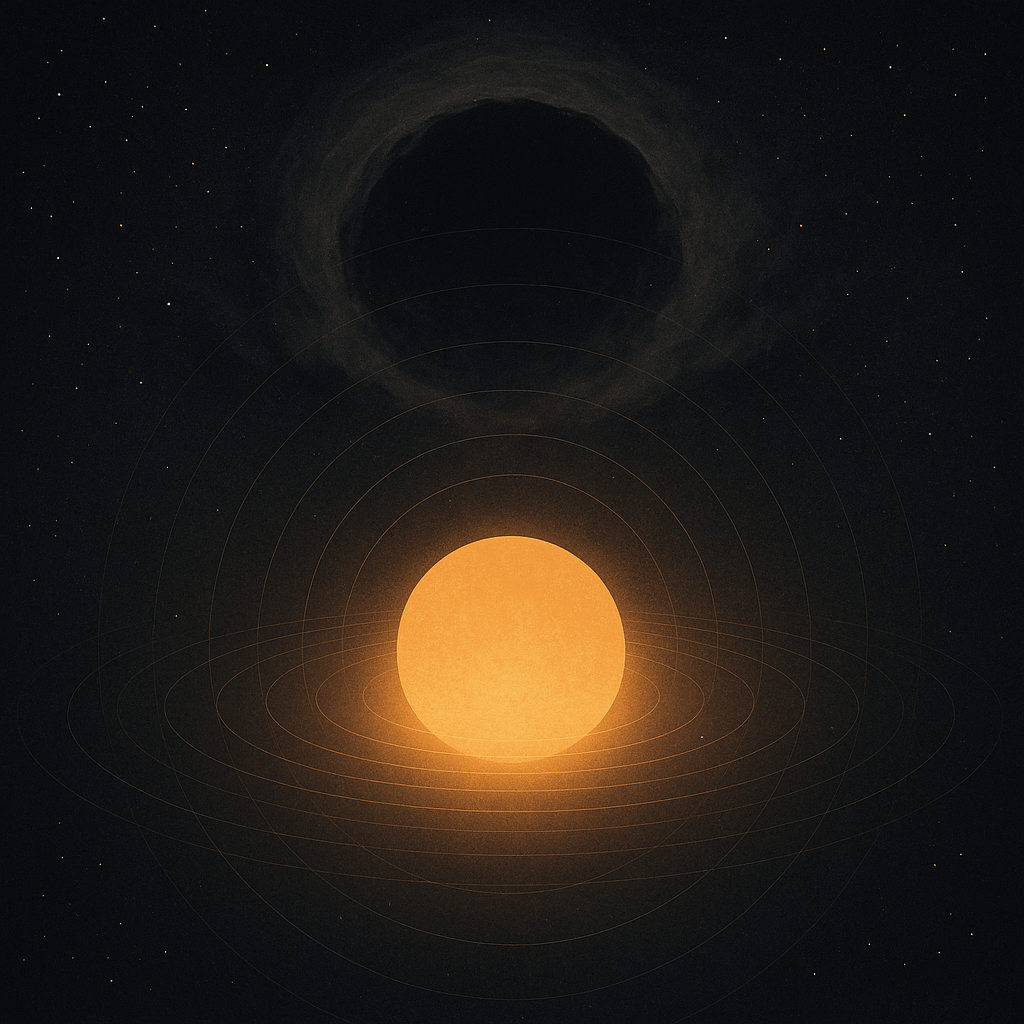
Now, this makom is not an available portion of space, for the spiritual realm is bereft of spatial dimensions. More precisely, it is a makom panui “void”, created “outside” of and by the Ein Sof, for otherwise, anything created in Him would be Him. And it was in that complete emptiness ̶ filled only with the reshimu “residue” of His Ohr ̶ that all things emanated.
These emanations — olamot, neshamot, and malachim — are purely spiritual and occupy no space at all. Yet they require a defined makom — not in the physical sense, but in the sense of ontological positioning. Even though they are not material, their existence unfolds within a spiritual framework that grants relational context — a “place” within the order of emanation and being.
Interestingly, even in contemporary physics, the idea of a “true void” has collapsed. What was once considered empty space is now understood to be a quantum vacuum — a field of latent potentials, fluctuations, and hidden structure. The vacuum is not nothingness, but a state densely encoded with possibility.
This unintentionally reflects the Torah’s deeper claim: that the makom panui — the “void” created by the Divine withdrawal — is not inert. It contains the reshimu, the residue of infinite light, and becomes the condition for all emanation. What modern science calls zero-point energy, Torah describes as the spiritual residue left behind to sustain being. The overlap is not semantic, but structural.
Then, how to explain a spiritual makom for creations that do not occupy space until the later creation of our physical universe?
Dimensionality in the Realm of Spirit
As it is known, our physical universe ̶ the final expression in the continuum of divinely created olamot ̶ the culminating link in the Seder Hishtalshelut “Chain of Evolution” ̶ from the abstract to the tactual and from the spiritual to the material. Thus, a makom that could support the physical creation at last was necessary. But the beginning creations were not physical, yet they all emanated in that same void.
In my humble understanding, the matter is this: the makom is a “spiritual space”. As such, it has “spiritual dimensions” intrinsically congruent with the spiritual realities emanated therein, in the same way the lower-level spatial dimensions accommodate physical reality.
For instance, in spiritual space:
- A thing’s “length” is its extent — how far it reaches, how low it descends. The Seder Hishtalshelut is an example of spiritual length: a thing evolves and metamorphoses in many steps and stages, from an abstract, ethereal state to successively coarser and more mundane forms, ultimately producing our physical world — the “lowliest” and most tangible embodiment of these upper realities.
- Spiritual “width” is a thing’s manifestation in numerous parallel forms and expressions. As the term implies, we are not speaking of greater and lesser forms or of closer and more distant expressions, but of parallel facets of a single truth, each as closely related to the original as the others.
- Spiritual “height” is its specific place in the spectrum of expressions of a particular level of kedusha.
Therefore, spiritual entities also occupy a “space” which defines their position in relation to each other and to the olam they occupy.
Time as a Consequence of Causal Order
One may think that these “conceptual space” characterizations are but mental constructs of physical phenomena, an attempt by our physical minds to contemplate and discuss metaphysical abstractions.
But the truth is this: physical space originates as a wholly spiritual phenomenon and then “descends” through the Seder Hishtalshelut, evolving into increasingly more concrete forms. Thus, physical space derives from “conceptual space”, which in turn evolved from an even more abstract form of space, and so forth. The higher we ascend the chain of hishtalshelut, the more abstract and ethereal is the space of that particular olam.
And the same is true for time. As it descends through the Seder Hishtalshelut, time is expressed in many forms: it is the essence of motion, causation, and change; it underlies the pulse of life, the processional nature of reason, and the pendulum of feelings and emotions. The Seder Hishtalshelut itself is a function of spiritual time, as the very concept of an “order” and an “evolution” presumes a reality governed by cause and effect.
Of course, the evolution of creation from spirit to matter did not “take time” in the ordinary sense ̶ Hashem did not have to “wait” for the successive phases and stages to yield their final product. In terms of physical time, the creation of the material world ̶ the result of the Divine desire for the creation process ̶ was instantaneous.
On the conceptual level, “time” is the framework within which the many levels of the created reality unfold. Time exists because Hashem desired that creation should constitute a process ̶ a chain of olamot extending from “heaven to earth”, each the product of its predecessor. Without time (on the most abstract level) there could not be a Seder Hishtalshelut; and without time (on the physical level), we — who can relate to spiritual concepts only as abstractions of their counterparts in our physical reality — could not conceive of, much less contemplate, the “order of evolution” linking the Creator’s most sublime works to our own world.
Closing Reflection
Just as a being cannot exist without a makom, so too no idea can emerge without a structure to receive it. These very thoughts arose because there was space within you to receive them.
This is the secret Torah reveals: that the world is not a location, but a permission for emergence. The beginning of Bereshit is not a moment — it is the formation of the very condition that makes moments possible.
We do not merely dwell within space and time ̶ we are structured within a Divine act of making room.
If this exploration resonated with you, consider subscribing below or writing to share your thoughts. Tehomia exists for such alignments.
Rabbi Avraham Chachamovits
Version 1.0 • Tammuz 5785 / July 2025
© 2025 Avraham Chachamovits. Licensed under CC BY 4.0
 TEHOMIA