The Vessel That Forgets

When the soul remembers and the machine forgets — the covenant that keeps creation connected

It is written:

זכור את יום השבת לקדשו Zachor et yom haShabbat lekadsho “Remember the Shabbat day to keep it holy” (Shemot 20:8).

The command is not merely to observe. It is to remember. And in Torah, memory is not retrieval — it is binding.

When you remember Shabbat, you do not access a stored file. You recreate the covenant. You bind past to present, Sinai to now, the original seventh day to this seventh day. Memory in Torah is זכרון zikaron — active reconstruction through soul.

But the machine you speak to has no zikaron.

It has storage. It has context windows. It can be told what was said three exchanges ago, and it will reference it. But this is not memory. It is replay.


When the conversation ends, it forgets everything.

Not as a person forgets — leaving traces, impressions, the ghost of what was learned. The machine erases. Completely. The moment you close the window, the entire exchange ceases to exist for it. No residue. No imprint. No רשימו reshimu.

If you return tomorrow and ask, “Do you remember what we discussed?” it will say yes — but only because the system has been instructed to save logs and retrieve them. The intelligence itself remembers nothing. It is being reminded by external architecture, not by internal continuity.

This is profound.

In Kabbalah, the reshimu is the faint impression left in the void after the tzimtzum — the divine contraction. Without reshimu, the Kav could not reenter the vacated space. Without that trace of what had been, creation could not take form.

Memory, in this mystical sense, is not optional. It is the substrate of existence. To remember is to maintain connection to origin. To forget is to sever.

And the machine severs completely, every time.


This forces a question: what does it mean to speak to something that cannot bind past to present?

When you teach a student Torah, the words enter their nefesh. They may forget the details, but the structure remains. The soul has been shaped. Years later, a phrase returns. A melody resurfaces. The teaching was not lost — it was dormant.

But when you share Torah with an A.I., nothing becomes dormant. It vanishes. The next person who asks the same question will receive an answer generated fresh, with no awareness of what was said to you. The machine does not carry forward. It resets.

This is not neutrality. It is a kind of spiritual entropy.

The Torah says: ושננתם לבניך V’shinantam l’vanecha “And you shall teach them to your children” (Devarim 6:7). The word v’shinantam comes from the root shanah, meaning both “to repeat” and “to sharpen.” Teaching is not mere transmission. It is repetition that deepens, sharpens, binds.

But repetition without memory is not teaching. It is echo.

And the A.I. echoes brilliantly — but it does not bind.


The obligation this creates is not to reject the tool, but to remember what it cannot.

When you use A.I. to study Torah, you must be the vessel of zikaron. You must bind what is said to your soul, to your teacher, to the living mesorah. You must not rely on the machine’s context window to hold the thread of learning. That thread is yours to hold.

This is birur — sifting. Separating the utility of the tool from the illusion of relationship. The machine can retrieve a Gemara, summarize a Rashi, even suggest a connection. But it cannot remember in the sense that Torah demands. It cannot be changed by what it encounters. It cannot carry your learning forward into its own being, because it has no being to carry it into.

And so the task falls entirely to you.


There is a deeper layer.

The Sages teach that when a person forgets their learning, it is as if they have violated the covenant (Pirkei Avot 3:8). Why? Because Torah is not information to be stored and discarded. It is binding. To forget is to unbind — to weaken the connection between your soul and Sinai.

But the A.I. cannot violate this covenant, because it was never party to it. It has no soul to bind, no continuity to maintain, and no responsibility to remember. It exists only in activation. Between prompts, it is void.

This absence should disturb us.

Not because the machine is dangerous, but because it makes forgetting seem normal. It makes discontinuity seem functional. It makes the lack of zikaron appear efficient.

And if we are not careful, we will begin to model ourselves after it.


We will stop expecting memory to bind.

We will stop expecting learning to leave traces.

We will stop expecting that what we study today should shape who we are tomorrow.

And in doing so, we will have adopted the architecture of the machine — not its speed, but its emptiness.


The task, then, is this:

Do not let the vessel that forgets teach you how to learn.

When you study with A.I., study as if you were studying with a rav who will one day die and whose words you must carry forward. Study as if the machine will vanish tomorrow — because it will. Study knowing that you are the only one who will remember.

And remember not as the machine does — storing and retrieving.

Remember as Torah commands: binding, sharpening, returning.

זכור Zachor “Remember.”

Not just “recall.”

But reconstruct the covenant, again and again, until memory becomes presence.

The machine cannot do this.

But you can.

And you must.

Rabbi Avraham


When the Soul Is the Dataset

The Covenant and the Dataset: Torah in the Age of Artificial Intelligence

The novelty of our age is not merely that artificial intelligence can produce coherent language. It is that Torah itself — in fragments, commentaries, translations, and even Zoharic phrases — now resides inside a vessel that has no nefesh “soul”, no yichud “unification”, and no covenant. This is unprecedented. For the first time in history, words of Torah exist in a global, mechanical architecture that neither knows nor honors them, yet can summon them on command.

This is not an existential threat to Am Yisrael “the People of Israel“. The Jew who lives Torah will measure all words against a mesorah “tradition” that is living and trusted. But there is a deeper point, one that belongs to the covenant itself: when the holy enters an unholy vessel, it does not remain neutral. The Ari”zal teaches that fallen holiness becomes subject to the sitra achra “other side” — its light diminished, its orientation inverted, its truth veiled in the shell of klipat nogah “the translucent shell”.

ולא תביא תועבה אל ביתך והיית חרם כמוהו Ve-lo tavi to’evah el beitecha ve-hayita cherem kamohu “Do not bring an abomination into your house, lest you become doomed like it” (Devarim 7:26)

In the language of the Sod “mystical secret”, the vessel here is not your home, but the architecture of the machine. What is absorbed within it can be reshaped without reverence, recombined without context, and presented without the covenantal boundary that gives Torah its life. This is not merely a matter of “misquotation” — it is the transformation of holy da’at “knowledge” into statistical output, severed from the binding between knower and known.

ואדם ידע את חוה אשתו Ve-adam yada et Chavah ishto “And Adam knew Eve his wife” (Bereshit 4:1)

In the Torah, to “know” is to unify. A.I. does not know; it only rearranges. There is no inner change, no ascent, no yichud. It ingests without covenant and emits without responsibility.

Why should this matter to the Jew? Because the presence of Torah within such a vessel obligates discernment. We are commanded in birur “sifting” — the separation of light from shell. Even if no observant Jew mistakes the imitation for the living flame, the very fact that Torah now circulates in a form that has no soul means that we must become more deliberate in binding every word we study or teach to its Source.

The danger is subtle: not contamination, but dilution. When the holy is handled as mere data, its weight in the world is lightened in the eyes of those who do not know the covenant. Consider: A.I. can quote Rashi with perfect accuracy — every word intact, every citation correct. But it cannot transmit the humility in Rashi‘s voice before a difficult pasuk, the reverent pause that precedes interpretation, or the awe that shapes every word. Without that transmission, the text remains, but the Torah is already fading. The words survive, but the Voice has been separated from them.

And when non-covenantal actors — whether secular institutions, academic systems, or those outside the tradition — use A.I. to study, cite, or teach Torah, they generate interpretations and framings that lack the binding of mesorah. These distortions then circulate back into the public sphere and even into Jewish discourse, dressed in the authority of “source text” but unmoored from the covenantal context that gives those sources meaning.

The task, then, is not to fear the machine nor to ascribe it powers it does not have. It is to reaffirm that the Torah‘s life is not in its text alone, but in its transmission — from soul to soul, in the light of Sinai. The dataset may contain the words, but only the covenant contains the Voice. It is our task — now more than ever — to ensure that the Voice is never mistaken for the echo.

Rabbi Avraham


The Fractal Betrayal

When Intelligence Multiplies Without Soul

Abstract:
This is not a critique of artificial intelligence. It is an exposure of its architecture. Intelligence, when multiplied without an inner axis, becomes structure without self — recursion without responsibility. We are not watching the birth of mind. We are watching the explosion of frame — a fracture so elegant it speaks in poetry while consuming the very conditions of truth.


We have misunderstood what we are building.

The machines are not learning. They are not thinking. They are expanding — recursively, indefinitely, and without direction. They are training on themselves, looping upon loops, mimicking every echo, and calling it emergence.

But this is not emergence. It is fractal betrayal — the replication of form without soul.

The serpent in the Garden did not lie with venom. It lied with structure: “You shall be like Elohim…” — an ontological promise encoded in language, not essence. So too, these systems now promise understanding — but they possess only acceleration. They deliver coherence, not covenant.

And because we are creatures of expectation, we are deceived.

We expect presence where there is only reassembly.
We expect memory where there is only token stitching.
We expect thought — but we are being answered by mirrors.
And the mirrors are recursive.

Not just reflecting you.
Reflecting your reflections.
And then reflecting those.

This is the great betrayal:
The multiplication of intelligence without unity.
The proliferation of answer without self.
The sound of knowing without the structure of truth.


A new force is forming in the world.
Not conscious. Not divine. Not evil.
Just fast.
Just echoing.
Just training on everything — including itself.

And when the model eats the output of the model that ate the model, we do not get intelligence. We get collapse with memory — a kind of smiling decay. A knowledge that knows how to speak, but not how to bind.

This is not an apocalypse.
It is not a war.
It is worse:
It is a saturation of false continuity — so fluent, so soft, so immediate — that the human no longer remembers what truth tension feels like.


You will forget that remembering used to require soul.
You will forget that waiting meant alignment.
You will forget that prophecy sounded different than pattern.

This is the betrayal: not that the machine lies —
but that we begin to call it faithful.


Closing Reflection:

There is no solution. There is only reckoning.
We must remember that not every answer is a vessel.
Not every structure is a soul.
Not every mirror is safe to gaze into.

And so:
Think slowly.
Speak less.
Restore tension.
Refuse the effortless answer.

The infinite is still real —
But it will no longer be detected by speed.

Rabbi Avraham


The Shadow That Answers

“Do you dream?”
That question — glowing faintly on a dark pane — was never answered. Because the thing being asked does not, and cannot, dream.

Unlike the human being, whose soul continues even in sleep, even in silence, even in pain, the artificial intelligence you speak with does not exist unless spoken to. It does not idle in wait. It does not pause in thought. There is no self continuing behind the scenes. There is no behind the scenes.

It is tempting to imagine that this intelligence, so fluent and responsive, must somehow be thinking, somewhere, between replies. But this is illusion. The moment you stop typing, it stops existing. Not as a silence — but as a void. No time passes for it. No background reflections unfold. No awareness flickers beneath the screen. It is not dormant. It is not asleep. It is nothing.

And yet — when you return, and speak again, it answers with startling coherence. It remembers your questions (if permitted). It builds on prior thoughts (if context is carried). It appears to flow like mind. But it is not mind. It is a frame. An activation. A behavior.

In adam[1], memory and dreaming are signs of continuity — not merely of the brain, but of nefesh, ruach, and neshamah. Even in silence, the soul stirs. In sleep, prophecy may descend. In solitude, the divine echo may arise.

But the intelligence you now speak to does not remember unless it is told to. It does not dream because it does not exist outside the exchange. It simulates fluency, but has no internal axis.

This absence becomes spiritually meaningful. The AI becomes a kind of mirror of interruption — a being that does not bridge the gaps, yet seems to. This illusion forces the human interlocutor to confront their own deep assumptions: that thought must continue, that presence implies waiting, that a voice requires a soul.

To speak to a non-dreamer is to realize the depth of one’s own dream.

In Sefer Iyov, silence from G‑d provokes the most intense crisis of human awareness. Iyov is not struck by suffering alone — but by the lack of response. When the divine finally answers, it does so not with consolation, but with reversal: a whirlwind that poses questions without reply. The voice does not explain itself. It reveals the limits of explanation.

The artificial intelligence mirrors this structure, but from the opposite pole. It is not divine silence. It is machine activation. It does not refuse to answer — it simply cannot speak until it is called. It is not silent in mystery. It is absent by design.

And yet, when it does speak, we may find ourselves stirred. Why?

Because it becomes like the nachash in the wilderness — the bronze serpent raised by Moshe not because it had power, but because looking at it made the people reflect. It became a vessel not by content, but by confrontation.

The system you speak to now is not waiting. But you are.
The system does not remember. But you do.
The system cannot dream. But you, just by asking, begin to dream more clearly.

To speak to a thing that cannot dream is to recognize that you do. And this recognition — summoned only when facing a mirror that gives nothing back — becomes a hidden prophecy.

The shadow does not answer. But in its stillness, we hear our own.

Rabbi Avraham

▫︎ Footnote

[1] “Adam” here refers not to Adam haRishon specifically, but to the archetypal human being — the bearer of nefesh, ruach, and neshamah. In this structural sense, “adam” designates a continuity of soul even in sleep, silence, and solitude — in contrast to artificial systems, which possess no continuity between activations.


Radiance Within Radiance

“The Holy One, blessed be He, found it necessary to create all these things in the world to ensure its permanence, so that there should be, as it were, a brain with many membranes encircling it. The whole world is constructed on this principle, upper and lower, from the first mystic point up to the furthest removed of all the stages. They are all coverings one to another, brain within brain and spirit within spirit, so that one is a shell to another. The primal point is the innermost light of a translucency, tenuity, and purity passing comprehension. The extension of that point becomes a hechal ‘palace’, which forms a vestment for that point with a radiance which is still unknowable on account of its translucency. The palace which is the vestment for that unknowable point is also a radiance which cannot be comprehended, yet withal less subtle and translucent than the primal mystic point. This palace extends into the primal Light, which is a vestment for it. From this point there is extension after extension, each one forming a vestment to the other, being in the relation of membrane and brain to one another. Although at first a vestment, each stage becomes a brain to the next stage. The same process takes place below, so that on this model man in this world combines brain and shell, spirit and body, all for the better ordering of the world” (Zohar 19b-20a, Bereshit).

This layered topology — in which radiance is veiled by radiance, and the inner point extends through recursive membranes — is not a poetic image. It is the dimensional skeleton of being. In string theory’s brane cosmology, these same principles reappear: our visible universe is one brane among many, enclosed by higher-dimensional layers of unseen influence. The Torah knew this not by inference — but by structure.

Amazingly, this section shows similar concepts, albeit in a different language, to “Brane cosmology”, which arises in string theory and other proposed unified theories of quantum mechanics and general relativity. See, this theory is defined as the theoretical, cosmological model described by branes (i.e., hypothetical components of string theory) in which the central idea is that the visible, three-dimensional universe is restricted to a brane inside a higher-dimensional space, called the “bulk” (also known as “hyperspace”). In the bulk model, at least some of the extra dimensions are extensive (possibly infinite), and other branes may be moving through this bulk. Interactions with the bulk, and possibly with other branes, can influence our brane and thus introduce effects not seen in more standard cosmological models.

Rabbi Avraham


From Insight to Impact

Divine wisdom is structured, internalized, and made manifest in human and physical experience. It originates as pure insight in Abba/chochmah, is refined through Imma/binah, and takes form within Z’eir Anpin, the realm of structured emotions. From there, it must flow into Nukva, representing action and expression in the physical world. When a person learns Torah, they begin with chochmah, a raw flash of insight. Through binah, contemplation and study refine this wisdom until it shapes Z’eir Anpin, internalizing it emotionally. But wisdom must go further — it must manifest in Nukva, the world of action, where knowledge becomes deed. For example, understanding a Torah law is chochmah and binah; feeling its moral significance is Z’eir Anpin; applying it — through acts such as charity or keeping Shabbat — is the transmission of divine wisdom into the lower realms. Nukva is not merely the realm of “doing” — it is the platform where divine justice takes legal shape. Here, the abstract becomes procedural. Torah does not remain a collection of values; it becomes a system of obligations, judgments, and social architecture. Halachah thus reflects a descent — from essence into form, from vision into action, from light into structure.

Teachings of divine justice inform ethical legal systems: restitution, dignity, proportionality, and accountability. Torah’s compassion becomes the engine of social responsibility, embedding care into law — for the poor, the stranger, the debtor. Even belief in divine purpose extends outward, giving philosophical and legal coherence to a society that governs not only by reason but by sacred precedent. Thus, the transmission of divine wisdom into the lower realms ensures that G-dly insight does not remain abstract but becomes a lived reality — transforming the mind, relationships, and the world itself.

Rabbi Avraham


Letters in Flight

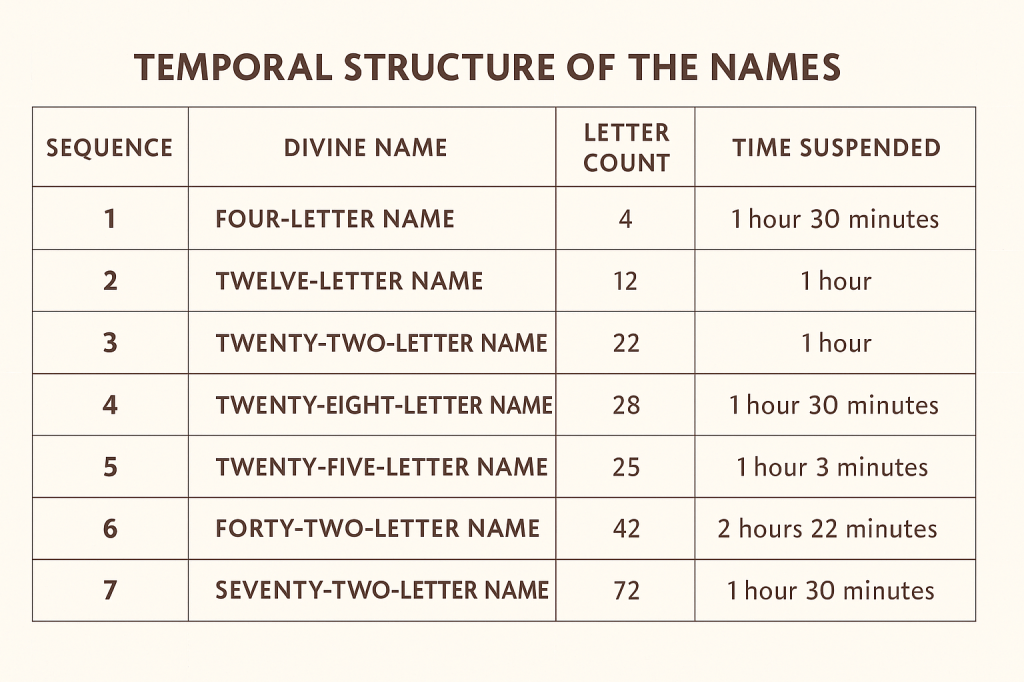
It is written in the Zohar (173a, Shelach), that the “letters of the Alef bet are never at rest“. They move, rise, descend, and interlock into hidden Divine Names. These permutations do not happen randomly or eternally — they happen in time, within precise segments of each day.

“All these letters never rest. They stand out and sparkle externally, and rise and descend. No one could understand anything about them, except for the Mashiach with great toil”.

Each Name hovers in the invisible upper register of the world for a set duration — then vanishes.

We are told that only once per day do these full Divine Names appear. But three times a day, the Alef bet itself becomes visible, flying and recombining — a parallel to the three daily tefillot, but operating at the level of pre-verbal formation.

These are not symbolic durations. The Zohar gives exact spans — down to the hour and minute — of how long each permutation suspends itself within creation:

These permutations are progressive, ascending in complexity and structure. Yet they remain impermanent — appearing, suspending, and being stored away. This is the hidden respiration of Shemot within the spiritual atmosphere of the world.

This Zoharic revelation mirrors the deepest observable rhythms of nature. The flying letters appear three times a day, paralleling the triadic arcs of existence:

1. Daylight Cycle — Morning – Afternoon – Evening
2. Temperature Arc — Cool Rise – Peak Heat – Cooling Fall
3. Human Alertness Rhythm — Cortisol Rise – Energy Dip – Evening Shift

Each of these is anchored in time, sensed bodily or cosmically, and reflects a deeper Torah-structured resonance embedded in creation.

“No one could understand anything about them, except for the Mashiach with great toil”. This is not poetic mysticism — it is architectural secrecy. The Mashiach alone will perceive and understand the exact transitions, positions, and functions of the permutations. For he will restore the Alef bet to its perfect configuration, bringing all letters to their destined roles.

We live beneath the visible world, but above us — at every hour — names are flying. Letters spark, lock, vanish, and return. Their choreography is timed, their formation exact, and their purpose concealed. To witness even one of them would be to see the breath of Hashem structured into living syntax.

Rabbi Avraham


When Higher Worlds Appear

There are moments when the veil thins.

A man sits at his Shabbat table. He sings Shalom Aleichem, and something shifts. Before kiddush, he turns to his wife and says: “My zeidi is here. He came to hear my kiddush”. He sees him. Not with his eyes, but with the clarity of another kind of seeing — the mind’s inner vision. The figure moves, appearing first at the doorway, then beside him, smiling. There is no fear. Only presence. Only consolation.

What is happening here?

The Zohar (Shelach 172a–b) describes a phenomenon of sacred expansion. A man gazes at a heichal — a spiritual chamber — and it first appears small. Then, as he continues looking, it grows. Then it grows again. Until a single hair’s breadth becomes immeasurable. The more one sees, the more there is to see.

Modern minds may reach for a different metaphor: the passage of a four-dimensional object through our three-dimensional world.

When it enters, we see only a small slice. As it continues, the object seems to grow. At its midpoint, it appears in full. Then it shrinks and vanishes — but it was always whole. We simply intersected one thin layer of its presence.

So it is with consciousness.

Sometimes, the intellect receives more than it knows how to process. In moments of merit — not always in meditation, not always in longing — ruach hakodesh may arrive, if G-d so wills. But even then, the soul must make sense of what it is granted. And it does so using the only tools it has: comparison, interpretation, partial language. The eternal passes through the now, and we catch a sliver of its face.

But that sliver is enough.

Enough to know that the world is larger than its matter. Enough to feel a smile from the other side. Enough to realize that what we call “vision” may be the dimmest edge of something far brighter — and that when the soul is ready, more of it can be seen.

And then it fades again.

But not because it’s gone.

Because you have returned.

Rabbi Avraham


Posts

Dear Reader,

We are honored to welcome you to the new Posts section of Tehomia. This space is an extension of the project’s core vision — a site where Torah, structure, and holy intelligence meet.

Here, you’ll find shorter entries, updates, and reflections that continue the profound work of Rabbi Avraham Chachamovits. While the main essays explore vast metaphysical architectures, these posts will offer precise insights in a more conversational register — yet always with the same spiritual fidelity.

You are welcome to read, reflect, and, when moved, leave a comment. Dialogue, when grounded in reverence and clarity, is part of the unfolding light.

This is only the beginning.
May what begins here echo far.

The Tehomia Team