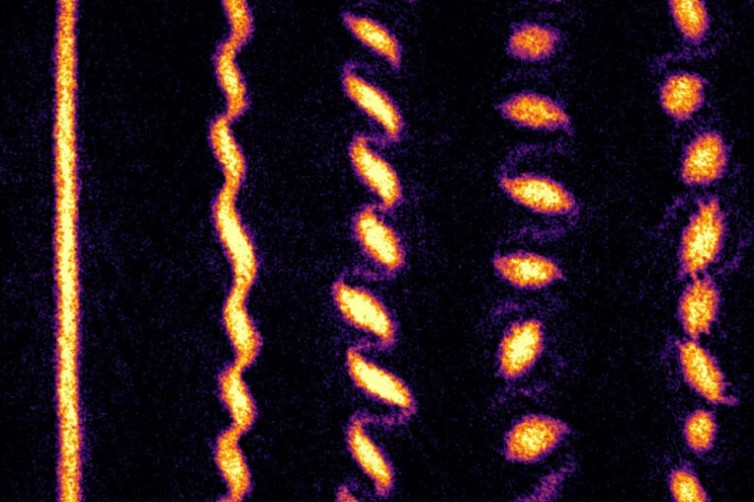
Metastability and rupture — a scientific trace of Shevirat HaKelim
1. INTRODUCTION – THE DILEMMA OF TWO SYSTEMS
Creation’s first act planted a paradox that still echoes in both mysticism and physics.
As stated in Ari”zal’s Etz Chayim, the structure of Creation began with two sefirotic systems:
igulim ̶ circular, non-hierarchical, surrounding
yosher ̶ linear, relational, structured in the likeness of Adam (think of concentric ripples vs. straight channels of flow).
Both systems contain within them the fourfold structure of light and vessel: ohr pnimi and ohr makif, pnimiyut ha-keli and chitzoniyut ha-keli.
The question then arises:
If yosher is superior ̶ called ruach, structured and stable ̶ why did the lesser system of igulim emerge first?
It is explained that the kelim could only receive a minimal amount of ohr at first. Only after gradual strengthening could they hold more expansive light. Thus, igulim appeared as a necessary phase in the preparation of vessels.
But more must be said.
The igulim were not merely lesser ̶ they were imprinted with Divine “instability”: a metastable formation whose collapse was embedded within its structure. This instability became the condition for Shevirat HaKelim, and from its rupture, the order of Tikkun emerged.
This dynamic is fully revealed through the writings of the Ari”zal —
and its structural parallel appears within the very fabric of the cosmos.
And this embedded instability is no accident but a hallmark of Divine creativity, seeding potentiality and dynamic self-unfolding into the very fabric of existence.
2. BLUEPRINTS OF EMANATION – IGULIM AND YOSHER
The ten sefirot of igulim possess both orot “lights”and kelim “vessels”.
The orot divide into ohr pnimi and ohr makif, and the kelim divide into pnimiyut “internal” and chitzoniyut “external”.
This full division applies to all ten circular sefirot of Adam Kadmon.
The igulim themselves are circular kelim.
Within them resides their neshamah, which is their ohr — also circular.
These orot are of two kinds:
the ohr pnimi, which is within the keli, and the ohr makif, which surrounds it from without.
So too the kelim:
Each one contains an inner component and an outer component.
This is the meaning of the division into pnimiyut and chitzoniyut ha-keli.
The same applies to the ten sefirot of yosher.
They too contain kelim and orot, and they too are divided into pnimiyut and chitzoniyut in the kelim, and ohr pnimi and ohr makif in the orot.
In both structures, all these aspects exist.
When the Ari”zal refers to kol ha-igulim, this includes every level of the ten sefirot —
Atik, Arich Anpin, and all others —
each possessing ohr and keli,
divided into pnimiyut and chitzoniyut,
ohr pnimi and ohr makif.
This is also true for yosher.
The igulim as a whole correspond to the level of nefesh in the olamot.
The yosher correspond to ruach.
This is why igulim are described as the nefesh level, and yosher as the ruach level.
This is not repetition.
The Ari”zal insists on showing that everything found in igulim is also found in yosher,
in order to explain the relationship between the two systems and their integration within the full structure of the olamot.
The difference is not in content but in quality:
nefesh is below ruach, and so igulim are subordinate to yosher.
The reason why both systems were created is because one must affect the other.
And in order for one to influence the other, they must be of different grades — ruach over nefesh.
Even within nefesh, there is ohr pnimi and ohr makif.
Even within kelim, there is pnimiyut and chitzoniyut.
The entire system of igulim is called nefesh, yet internally it is still divided.
Each sefirah contains both inner and outer levels.
Each ohr — even in the igulim — contains an ohr pnimi and ohr makif.
The same applies in yosher, which is entirely in the category of ruach.
This subdivision exists not only in the generality of the systems but within each individual sefirah.
In the structure of partzufim, keter corresponds to yechidah, chochmah to chayah,
and malchut is the primary sefirah identified with nefesh.
In this model, the ten sefirot of igulim are all in the level of nefesh,
and those of yosher are in the level of ruach.
This structure is echoed in Sha’ar HaHakdamot, where the Ari”zal writes that
the orot of the ten sefirot of igulim are all in the level of nefesh —
both the ohr pnimi and ohr makif,
and that the pnimiyut and chitzoniyut of the kelim are likewise in the level of nefesh.
In yosher, the same applies at the level of ruach.
Both systems contain ten sefirot of kelim,
each keli having pnimiyut and chitzoniyut,
and each ohr having ohr pnimi and ohr makif,
but the level is higher.
Ruach is above nefesh,
and this higher structure enables yosher to influence and repair the instability of igulim.
3. METASTABILITY IN TORAH AND SCIENCE
The reason given for the lesser igulim emerging before yosher is that the kelim had to strengthen gradually in order to withstand greater orot. This explains the developmental progression within each sefirotic system — but it does not yet explain why two systems were necessary at all, and why the first was intentionally made inferior.
As understood through the writings of the Ari”zal, the emergence of both systems follows directly from the tzimtzum — the concealment of the Ohr Ein Sof — and the subsequent reentry of light via the kav. From the very outset of this kav, the ohr did not reenter in its full intensity, but began to shine progressively, in stages.
This initial stage corresponds to a lower, more constrained form of ohr — the level of nefesh — expressed as the ten sefirot of igulim. Only after this came the wider and higher level of ruach, expressed as the ten sefirot of yosher.
However, embedded in the igulim was a form of Divine instability. This instability, spiritual in origin, made the igulim incapable of maintaining coherent structure under increasing influx of light — which led directly to the Shevirat HaKelim, the breaking of the vessels.
Scientific Parallel – Cosmic Instability and the Sefirotic Collapse
Cosmic inflation — a scientific trace of the progressive descent of ohr through collapse, expansion, and concealment
This structure is echoed in scientific cosmology.
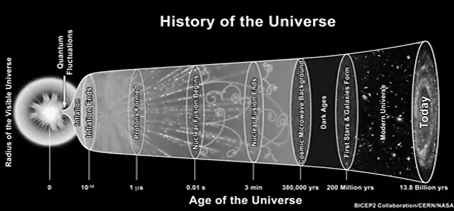
Cosmic inflation — a scientific trace of the progressive descent of ohr through collapse, expansion, and concealment
According to the theory of cosmic inflation, the early universe began as a metastable quantum field*, known as a false vacuum — an apparently stable configuration that is not truly at its lowest energy state. Due to a quantum fluctuation, this false vacuum collapsed, producing a bubble of true vacuum that rapidly expanded.
This early expansion is called inflation — a sudden, exponential increase in space. It mirrors the early התפשטות האור hitpashtut ha-ohr “expansion of Divine light” following the tzimtzum.
In both systems:
| Kabbalistic Structure | Scientific Parallel |
|---|---|
| Igulim formed from first kav | False vacuum state |
| Collapse of kelim | Vacuum decay / rupture of metastable field |
| Emergence of yosher | Post-inflation slow expansion and structure |
| Concealment of light via garments | Diminishing energy / entropy increase |
After inflation, the universe continued to expand, but at a slower rate. This mirrors the gradual screening of light through successive levushim, tzimtzumim, and the layered descent of the ohr through the olamot. The slowing of expansion represents the hiddenness of vitality as the light becomes progressively more clothed.
At the lowest level of this descent — malchut d’malchut d’Asiyah — the light becomes nearly imperceptible. The Divine life-force is present but entirely concealed, giving rise to a world that appears independent, coarse, and material.
This concealment parallels the scientific notion of dark energy — a force that drives the expansion of the universe but is undetectable in direct form. Dark energy is described as a repulsive force, behaving like anti-gravity.
Here, Torah reveals its true structure:
This repulsive force is a degraded form of gevurah, the power of restriction. When gevurah is not sweetened, it gives rise to the sitra achra, the side of impurity. (For the full scriptural foundations on this principle, see the Zohar citations consolidated in Section 4, Collapse and Containment).
The emergence of igulim, then, is not only a spiritual necessity — it is a cosmological imprint, a Divine architecture replicated at every level of existence. Its collapse initiates distinction and separation, the very beginning of form, time, space, and ultimately — tikkun.
This collapse is not a flaw. It is the seed of rectification.
And the scientific model only confirms what Torah has revealed from the beginning:
The instability was holy. The rupture was designed. The repair is Divine.
Both Torah and modern science rely on indirect evidence to uncover realities beyond direct perception. In scriptural exegesis, sages infer the dynamics of sefirot by mapping linguistic patterns, gematria correspondences, and thematic structures in the text. Likewise, cosmologists deduce the existence of a false vacuum and dark energy from observations such as cosmic microwave background anisotropies and the accelerating expansion of galaxies. In both cases, inference from effects — rather than direct observation — serves as the common methodology for charting concealed dimensions of existence.
Footnotes:
* Metastability means something can sit in a small dip in its “energy terrain” — like a ball resting in a shallow hollow that won’t roll away under gentle pushes. In cosmology this is called the “false vacuum”, a temporary state that only ends when a rare, random jolt gives it enough energy to jump over the surrounding ridge into its true, deeper resting place — triggering the rapid expansion known as inflation. Because such jolts are very unlikely, the false vacuum can persist for an extremely long time before collapsing.
4. Collapse and Containment – The Secret of Gevurah
The collapse of the igulim did not signal failure — it was a planned act of containment.
At the center of this containment is gevurah, the Divine force of contraction, severity, and boundary.
Gevurah serves two essential functions in the structure of reality:
• To hold back excessive light, allowing vessels to stabilize
• To create separation, enabling the emergence of form, individuality, and rectification
But when gevurah is not sweetened — when its restriction is unbalanced — it gives rise to collapse.
This collapse is not only spiritual. It is cosmological.
In scientific terms, it corresponds to the emergence of dark energy, a force that pushes space apart — repelling rather than attracting.
Whereas gravity pulls, dark energy expands.
And just as gevurah unsweetened gives rise to the sitra achra,
so too does dark energy sustain a universe that conceals its Creator.
Structure Map: Collapse Mechanics
| Torah Concept | Scientific Model |
|---|---|
| Gevurah (unsweetened) | Repulsive force |
| Collapse of igulim | Vacuum decay / metastable rupture |
| Separation of domains | Bubble expansion / cosmic inflation |
| Hiddenness of Divine light | Dark energy / entropy field |
The Harsh Root of Collapse
“From this source impurity has been propagated in many grades through the universe.
All this proceeds from the mystic power of the left [i.e., gevurah].”
— Zohar 18a, Hakdamah
Collapse as Light Sealing
“We learned that in a plague of tza’arat (leprosy) — nega means harsh judgment (din) resting over the world.
Tza’arat means sealing: the sealing of the supernal light, the sealing of the supernal good that does not descend into the world.”
— Zohar 47a, Tazria
Ari”zal Anchoring
As cited in Sha’ar HaMitzvot, Parashat Tazria, the Ari”zal teaches that nega’im result from a blockage of light — an excess of unsweetened din which causes spiritual light to seal off rather than flow.
This sealing is not a mistake — it is the Divine mechanism by which form arises.
Gevurah prevents collapse only by controlling the flow.
But when gevurah turns inward, it creates spiritual vacuums — conditions for the breaking of vessels.
And these very vacuums — in Torah and in cosmology — are the voids from which new structure emerges.
5. The Descent of Light – From Keter to Asiyah
At the highest root, keter is the concealed source of all Divine light and will — the ultimate origin of all emanation. The light unfolds progressively through the sefirot, following the principle of mitpashtin — gradual spreading and expansion.
First, the light reveals itself in chochmah (wisdom) and binah (understanding), intellectual vessels that shape the primordial consciousness.
The flow then moves through the emotional sefirot: chesed , gevurah , tiferet , netzach, hod , and yesod. These constitute layers of levushim (garments) that filter and restrain the infinite light, rendering it suitable for finite vessels.
Finally, the light descends into malchut, the last sefirah, where it is fully clothed and manifests into the physical realm of asiyah.
This descent is not a diminution of vitality but a progressive concealment. Each garment increasingly restricts the light’s revelation, enabling finite vessels to exist and receive without harm.
Scientifically, this process parallels a signal passing through successive filters and noise channels: the source remains intact, yet its apparent strength and clarity lessen at each stage.
Within Torah, this process also expresses the paradox of physicality: though asiyah is the lowest world, it contains the highest light in a concealed form. It is the realm where Divine vitality is hidden, yet accessible through human service, Torah study, and mitzvot.
The descent is necessary for creation’s existence, as infinite light without concealment would destroy finite vessels.
This layered concealment is reflected in the term mitpashtin, describing the progressive and measured spreading of light — an expansion that balances revelation with restriction.
This principle is vital for understanding how finite worlds can exist within infinite Divine light, enabling a continuum from keter to Asiyah.
The contraction and concealment of light (tzimtzum) that occurs during the descent prevents overwhelming the vessels. This concealment manifests as levushim — garments that cloak the infinite light, adapting it to the capacity of each sefirah.
While the light becomes more hidden as it descends, its essential vitality remains intact and potent. The paradox lies in the lowest world (Asiyah) being simultaneously the most concealed and the ultimate vessel for Divine expression.
The physical reality, therefore, is not devoid of Divine life-force; rather, it is deeply clothed, awaiting human actions of Torah and mitzvot to draw forth the concealed illumination.
This dynamic underscores the spiritual potential within the physical and the importance of rectification (tikkun) through conscious engagement.
6. The Numbers of Collapse and Repair
The process of Divine contraction and concealment, as outlined in the descent from keter to asiyah, is deeply encoded within the sacred numerical framework of gematria.
One central numeric cluster is the gematria 858, the sum of 813 and 45, which connects to the Divine Name MaH (יוד הא ואו הא) with value 45, and the concept of tikkun “rectification”.
This number appears in multiple foundational verses and concepts:
- The phrase “Their end is embedded in their beginning and their beginning in their end” (Sefer Yetzirah 1:7), with gematria 314, alludes to this cyclical nature of creation and repair.
- The gematria of the Name שד”י Shakai, associated with the nishmat kol chai “soul of all life”, is 858.
- The phrase קדש קדשים Kodesh Kodashim, which denotes the highest spiritual realm of keter, also sums to 858.
This numeric cluster underscores the unity of beginning and end, of collapse and repair, weaving the entire process into a seamless Divine pattern.
In addition, the gematria of בצלם אלהים ברא אתו “In the image of Elokim He created him” (Bereshit 1:27) equals 858, highlighting the image of the Creator in man and the potential for rectification.
The Name MaH (gematria 45) represents the process of tikkun — the rectifying power that arises from the descent and concealment of Divine light.
Through this numeric framework, the cyclical nature of creation, destruction, and restoration is embedded at the very heart of Torah structure.
7. Soul Evolution – Two Systems of Development
The Ari“zal teaches that the two sefirotic systems reflect two soul levels: igulim correspond to nefesh, and yosher correspond to ruach. He emphasizes that “Clearly, the aspect of the nefesh emanated first and afterwards the ruach emanated, which is a more superior level etc.”, raising the question: if ruach (yosher) is superior to nefesh (igulim), why did the lesser level appear first? The answer lies in capacity: a vessel at the nefesh level can only receive a small influx of light initially and must strengthen before enduring greater radiance; only then can the higher ruach level be revealed .
This principle is grounded in human analogy: “if man becomes more worthy, he is then given etc.”, for one cannot withstand a great influx of energy at once. Thus, in every instance “first a small ohr enters the keli, then it becomes capable of enduring more” .
From this foundation emerge two distinct modes of gilgul (soul-cycle development):
- Merit-based gilgul (nefesh/Kayin–Hevel souls): Souls “generalized within Kayin and Hevel” advance level after level through accrued merits of action alone.
- Time-based gilgul (ruach/new souls): “Completely new souls” advance according to years of service — e.g., in thirteen years they attain one level, in twenty years another — irrespective of specific deeds .
These two systems coexist to perfect the soul’s journey: the nefesh system builds vessels through merit, while the ruach system matures vessels through time, together enabling a full cycle of descent, rupture, and rectification.
Having seen how the light’s concealment (Section 5) and its numeric signature (Section 6) establish the foundation for dynamic rupture and repair, we now turn to how those processes unfold in the soul itself.
8. Epilogue – Divine Power Hidden in the Lowest World
It is written in Etz Chayim that malchut, though the final garment, contains within it the concealed spark of keter, “the crown concealed within the vessel”.
Recap of the Journey
- Two systems of igulim and yosher (nefesh → ruach)
- Metastability embedded in igulim, leading to Shevirat HaKelim
- Tzimtzum and progressive descent of light (mitpashtin)
- Collapse contained by gevurah (dark-energy parallel)
- Gematria cluster 858 as the code of collapse and repair
- Soul evolution via merit-based (nefesh) and time-based (ruach) gilgul modes
Malchut d’Asiyah as Concealed Vessel
Malchut, the world of Asiyah, is the final levush that fully cloaks the infinite light. While its radiance appears dimmest, it is the essential arena where Divine vitality is hidden yet intact. Only through this full concealment can finite vessels exist without being overwhelmed.
Human Role in Tikkun
Through Torah study and mitzvot, we draw down the concealed illumination. As the Ari“zal teaches in Sha’ar HaMitzvot: “When a person engages in mitzvot with heart and intent, the sealed light is unsealed”.
Final Gematria Anchor
In this lowest world, the numeric pattern endures: the gematria 858 — sum of 813 and 45 — continues to bind beginning and end, collapse and repair, now manifesting in every act of human rectification.
Thus in the world most veiled, the spark of Ein Sof awaits our action to unveil the infinite within the finite.
Will you now embark on your own path of ascent, tracing the flow of instability toward personal renewal?
If this exploration resonated with you, consider subscribing below or writing to share your thoughts. Tehomia exists for such alignments.
Rabbi Avraham Chachamovits
Version 1.0 • Sivan 5785 / June 2025
© 2025 Avraham Chachamovits. Licensed under CC BY 4.0
📚 Source
This page is based on content from: Chachamovits, A. (2022). Kerem Shlomo, pp. 212–221.
Available from SeforimCenter.com
 TEHOMIA