
The Holy Geometry of Order, Collapse, and Return
1. Eden and the Collapse of Structure
The notion of entropy, commonly defined as the degradation of structure and the increase of disorder, appears already in the very first descent of the created world: the fall from Gan Eden. However, this is not a thermodynamic statement, but a metaphysical one — and the Torah’s wisdom reveals that this cosmic unraveling was not simply a punishment, but a systemic rupture in the spiritual architecture of existence.
Prior to the transgression of Adam, the dimensions of Gan Eden and the physical Olam HaZeh were nested systems, with the spiritual surrounding and permeating the physical in a balanced, living hierarchy. Gan Eden served as a higher-dimensional envelope, operating as a kind of supernal domain in which humanity functioned as a bridge between realms.
The verse says:
ויקח ה’ אלה”ים את האדם וינחהו בגן־עדן לעבדה ולשמרה
“And G-d took the man and placed him in the Garden of Eden to work it and to guard it.” (Bereshit 2:15)
The Zohar and the Arizal reveal that this dual directive — לעבדה le’avdah “to work it” and לשמרה le’shamrah “to guard it” — concealed profound cosmic roles. According to the teachings of the Ari”zal, le’avdah refers to the avodah of Adam in repairing the fragmentation that occurred within the Partzufim of Ze’ir Anpin and Nukva after the shattering of the zayin melachim, the primordial seven kings of Edom who did not endure. Le’shamrah, in contrast, was a spiritual safeguard: to prevent the influx of higher light from descending into the lower realms in a manner that could not be contained — triggering collapse and fragmentation of inner order.
Adam’s failure reversed the vector of holiness: instead of preserving the boundary between higher and lower worlds, the sin catalyzed an unprecedented exposure — where orot “lights” rushed downward into unprepared kelim “vessels”. The result was not merely exile from Gan Eden but the metaphysical enfolding of the garden into the world of concealment. Eden became התלבש hitlabesh — it became “enclothed” — inside the very structure of the physical world.
Thus, what we call “entropy” in the physical domain is in fact the visible symptom of a deeper ontological collapse. It is the result of חטא אדם הראשון — the sin of the first man — in which the stable structure of holy domains was compromised, and the spiritual coherence of the universe began to degrade. Not by accident, but by consequence.
This Torah-based entropy is not a statistical inevitability, but a spiritual process: the descent of unified reality into fragmented concealment. It remains active until the full tikkun of the world is achieved.
2. Entropy as the Imprint of Sin
The concept of entropy in science typically refers to the increase of disorder or the loss of usable energy within a closed system. Yet in Torah thought, disorder is never just physical; it is ontological — woven into the structure of reality by the moral and spiritual choices of sentient beings. The collapse from Eden into ולם הזה Olam HaZeh “this world” is not just mythic history, but the initial rupture of a world where order was not merely probable — it was embedded.
The sin of Adam introduced a distortion into the cosmic fabric. The unity of the partzufim — the harmonized vessels of divine expression — was broken. As the Ari”zal describes, when lights descend into vessels that are not yet rectified, the vessels shatter (shevirat hakelim), and their shards descend into the lower worlds, dragging divine sparks with them. This process gives rise to what is later identified in Kabbalah as the structure of עולמות לפני תיקון olamot lifnei tikkun — worlds in need of repair.
Entropy in this deeper frame is not simply about temperature or randomness. It is about the loss of fit between light and vessel, between purpose and structure, between soul and reality. Sin disrupts the resonance between divine order and the vessels of creation. Once misalignment enters, energy dissipates in the wrong places, and kelim no longer retain their original form. This is spiritual entropy.
Chazal hinted at this subtly. The Torah does not describe the immediate world after Adam’s fall as evil, but as cursed:
ארורה האדמה בעבורך
“Cursed is the ground because of you” (Bereshit 3:17)
A curse in this sense is a distortion — a condition in which the natural capacities of creation are turned against their original harmony. This is the Torah’s framing of disorder. Not neutral, not automatic, but a result of volitional breakage.
Entropy, then, is not a statistical trend but a spiritual echo — the residue of misaligned intention in the very architecture of being. Each act of chet “transgression” continues to widen this gap. And each act of tikkun — repair — becomes a reversal of this entropy: a restoration of structural coherence between the physical and the divine.
3. The Scientific Expansion of Entropy
Thermodynamic Entropy
Thermodynamic entropy refers to the tendency of systems to lose usable energy and drift toward equilibrium — a state of maximum disorder and minimum potential. The Second Law of Thermodynamics states that in a closed system, heat flows from hot to cold, structures degrade, and order decays unless energy is continually infused. Formally, this is expressed by Boltzmann’s entropy formula:
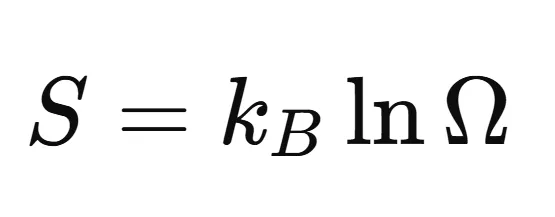
This equation states that entropy increases with the number of microscopic configurations (Ω\OmegaΩ) that correspond to a system’s macroscopic state. The more ways a system can be internally arranged without changing its outward appearance, the higher its entropy. As an example: A Shuffled vs. Ordered Deck. An ordered deck (e.g., all spades, then all hearts, etc.) is very specific — there’s only 1 way to arrange the cards like that.
→ Very low Ω → Low entropy.
A shuffled deck can look like almost anything — and millions of microstates (specific card arrangements) still “look random”.
→ Extremely high Ω → High entropy.
In physical terms: systems naturally tend toward the macrostate that has the most microstates. That’s why randomness (disorder) is overwhelmingly more probable — it simply has more ways to exist.
Torah Parallel: This mirrors the collapse of kelim that cannot retain the ohr — divine light. When vessels are unrectified, light overflows or dissipates, leading to shevirah, the shattering of form. In both domains, unchecked energy release leads to fragmentation. Entropy is the thermodynamic signature of spiritual imbalance — the heat-death of holy structure.
Informational Entropy
In the language of information theory, entropy measures the degree of uncertainty or disorder in a message. Formally defined by Claude Shannon, it is given by:
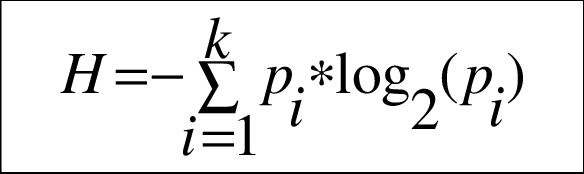
This formula quantifies how unpredictable a system is: the more uniform and uncertain the distribution of possible outcomes, the higher the entropy. In Torah terms, this corresponds to a state in which the inner devarim — words, meanings, and intentions — are scattered, distorted, or hidden. Clarity and purpose reduce entropy. Sin, confusion, and spiritual concealment increase it.
As an example: A Coin Toss Message.
- A message saying: HHHHHHHH (all heads) has low entropy — it’s highly predictable.
- A message like: HTTHTHHT has high entropy — each bit is uncertain. If you don’t know the bias of the coin, the unpredictability of the message increases → The more unpredictable the content, the higher the informational entropy.
Torah Parallel:
A soul filled with clear kavanot and pure ratzon transmits “HHHHHHH” — pure, aligned light. But confusion, sin, or inner fragmentation creates noise — scattered outcomes, higher entropy. Just as informational entropy reflects signal distortion, so too does the soul experience fragmentation when its inner clarity is compromised. When a person distances from Torah, the alignment between thought, speech, and action weakens — meaning becomes noisy, intention scatters. Torah is the divine syntax that restores coherence: reducing uncertainty, refining perception, and reconnecting scattered sparks into ordered meaning.
Gravitational Entropy
Gravitational entropy, particularly in black hole physics, paradoxically increases as matter collapses into order. The Bekenstein–Hawking formula defines the entropy of a black hole as proportional to the surface area of its event horizon:
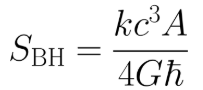
This equation reveals a counterintuitive reality: as matter collapses into a singularity, entropy, rather than decreasing, surges. Instead of disorder dispersing, it becomes compressed into informational density encoded on the event horizon. In Torah terms, this reflects the hidden potency of descent: that within collapse lies concentrated potential for elevation — like sparks trapped in darkness awaiting release.
As an example: Star → Black Hole.
- A star is a complex, structured object.
- When it collapses into a black hole, it seems like it loses structure — yet entropy increases.
The black hole’s entropy is not measured by how much matter is inside it, but by the surface area of the boundary that surrounds it — called the event horizon. This horizon marks the point beyond which nothing can escape.
→ The more mass the black hole has, the larger this boundary becomes — and the greater the amount of hidden information it can encode. That means: more mass → bigger surface → higher entropy.
Torah Parallel:
Collapse (shevirah) isn’t just destruction — it condenses hidden light (i.e., nitzotzot “sparks”) into potent form, like how a black hole conceals vast structure in its event horizon. This is the mystery of descent for the sake of ascent. A soul may fall, a generation may rupture, yet from within that compression — that singularity — arises a deeper form of order. In Kabbalah, these are the nitzotzot trapped within the klipot that can only be redeemed through descent and return.
Synthesizing the Three Dimensions of Entropy
| Scientific Framework | Physical Meaning | Torah Resonance |
|---|---|---|
| Thermodynamic | Heat disperses; order degrades | The world collapses where vessels are impure |
| Informational | Clarity erodes as uncertainty increases | Sin corrupts signal; Torah refines perception |
| Gravitational | Collapse forms denser order | Descent births redemption through concentration of sparks |
Closing Insight
Entropy is not the enemy of Torah — it is its canvas. Where the world decays, Torah rebuilds. Where signals blur, Torah tunes the soul. Where collapse threatens, Torah prepares new light. In each mode, entropy reveals the cost of disconnection — and the immense power of repair.
If this exploration resonated with you, consider subscribing below or writing to share your thoughts. Tehomia exists for such alignments.
Rabbi Avraham Chachamovits
Version 1.0 • Sivan 5785 / June 2025
© 2025 Avraham Chachamovits. Licensed under CC BY 4.0
This page is based on content from: Chachamovits, A. (2022). Avraham BaMidbar – Kabbalistic Writings, pp. 43–44.
Available from SeforimCenter.com
 TEHOMIA