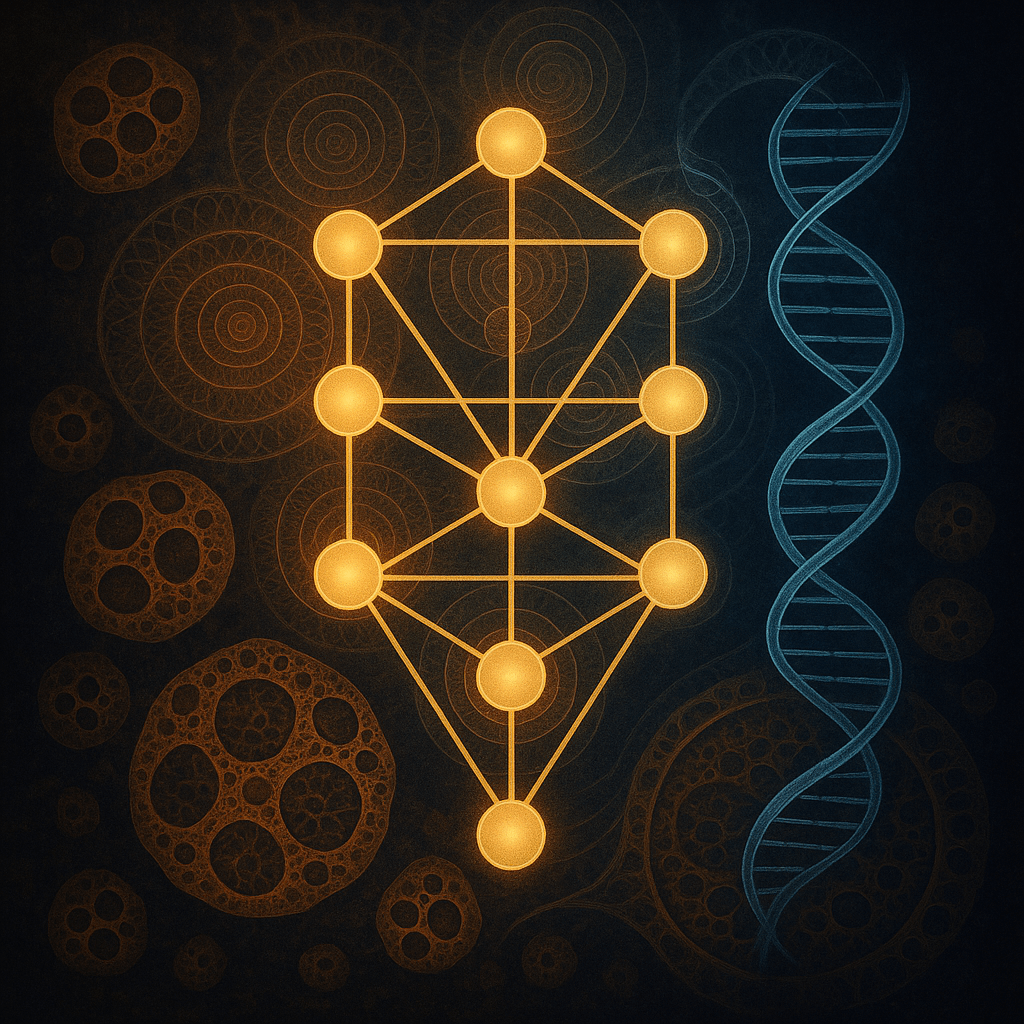
Torah Structures in Biological Complexity
The sefirotic paradigm, established by Divine design, is the very root and essence of all forthcoming living evolutionary processes. No biological formation, adaptation, or complexity can emerge without tracing back to the primordial structures encoded within the worlds of Atzilut, Beriyah, Yetzirah, and Asiyah. These structures are not metaphorical — they are architectural.
In secular biology, evolution is defined as the process through which various types of plants, animals, and other living beings on Earth originate from preexisting types, with differences arising through modifications inherited across generations. This is described as “descent with modification”, and it accounts for the diversity of species observed across geological time.
But beyond this material mechanism lies a deeper trajectory — one raised to a higher standard: orthogenesis*. This is the view that evolution follows a directional path, aimed toward increasing order or complexity. Though modern science has largely abandoned orthogenesis due to its teleological** implications, Torah affirms precisely such a trajectory. Evolution is not aimless — it is structured by a cosmic telos (that is, an inherent Divine purpose built into the structure of creation).
Let us recall that in the structure of soul development, the nefesh is given at birth, while the ruach is only acquired later, and only through merit. The Ari”zal establishes this ascending model in Sha’ar HaGilgulim, noting that the soul does not enter the world complete, but unfolds in layered stages — from foundational life-force to spiritual refinement. This pattern is not merely psychological or moral. It is ontological. The very structure of the worlds parallels this progression. Just as nefesh precedes ruach in the soul, so too do the iggulim precede the yosher in the emanation of the sefirot. And just as the ruach introduces hierarchy, direction, and internal structure to the soul, so too does yosher elevate the static circularity of iggulim into ordered complexity.
The yosher–ruach sefirotic model, central to the design of Olam HaTikkun, is a more developed, complex, and rectified system than the iggulim–nefesh formation that preceded it. This progression mirrors the spiritual path of the soul. As the Ari”zal teaches:
ובתחלה נוטל חלק אחד הגרוע שבכלם, והוא הנקרא נפש ואח״כ אם זוכה יותר, יקח גם את הרוח
“He does not acquire all of them at once, but rather [he acquires each level] based upon his ‘merits’. At first he takes the lowest of them all called nefesh. After that, if he merits more, he also takes a ruach” (Sha’ar HaGilgulim, Hakdamah 1).
While the nefesh and ruach are distinct spiritual entities, the merit that enables the acquisition of ruach is evolutionary in structure — it reflects a dynamic process of internal refinement, layer by layer. This is a spiritual analog of orthogenetic development. The human being — and by extension, creation itself — ascends through structured complexity.
As the Ari”zal explains, iggulim are circular and self-contained — separated from one another and only tenuously connected through narrow conduits (chalonot). They surround, but do not integrate. As such, they represent the level of nefesh: foundational, present, but lacking inner hierarchy. Yosher, by contrast, is upright and inter-connected, with each of its ten kelim forming a single unified configuration — the likeness of man. This is the domain of ruach: complexity, order, and internal structure. Thus, the nefesh–ruach distinction is not metaphorical but ontological, grounded in the geometries of Divine light itself.
Creation, by Divine will, was designed to be multifarious in potentia. This diversity is a direct consequence of the fragmentation of the vessels in Shevirat HaKelim — a cosmic rupture that scattered countless nitzotzot “sparks” across all levels of being. These sparks, embedded in creation, endowed it with inherent multiplicity.
Multiplicity, in turn, implicates complexity: a system whose components interact in varied ways, following internal rules that generate nonlinearity, emergence, randomness, hierarchy, and self-organization. These are not foreign concepts to Torah — they are manifestations of the concealed dynamics rooted in the unfolding of olamot, partzufim, and sefirot.
Yet among all models of complexity, only one reflects a fully rectified structure: the model grounded in התכללות hitkallelut “inter-inclusion”.
Hitkallelut is the principle that each component contains within itself some aspect of all others — that the whole is reflected in every part, and every part participates in the whole. In Etz Chaim, this is described explicitly: each of the ten sefirot contains within itself all ten — chokhmah she’b’chesed, gevurah she’b’tiferet, and so on. Without this internal structure, no rectified interaction is possible. This pattern repeats fractally across all levels of creation — from Divine light to human soul to biological form.
Unlike the iggulim, which remain distinct and isolated, the kelim of yosher form a unified vessel capable of integration. Every sefirah interconnects within the same vertical likeness, creating lateral and hierarchical pathways. Only such a structure permits hitkallelut. This integration is not cosmetic — it is the condition of repair.
Furthermore, this dual structure of iggulim and yosher is not confined to Adam Kadmon alone. As the Ari”zal makes clear, every olam, every partzuf, and even every sefirah contains within it both aspects — iggulim and yosher — scaled according to its position and function. This structural duality recurs at all levels of reality. Evolution, then, is not a one-time emergence but a recursive and scalable ascent toward internal integration.
Underlying this ascent is the Kav — the straight, inner beam of Divine light that pierces the void and enters the olamot. It is the source of both the orot pnimiim and makifim, and is only fully clothed and received within the structure of yosher. The iggulim, though encompassing and closer to the ohr sovev, remain external and incapable of containing the full light. The yosher vessels, by contrast, receive the Kav internally, allowing true development to unfold.
Therefore, in the current reality of Olam HaTikkun, all valid evolutionary paths must ultimately evince hitkallelut. The true mark of progress — in nature, in soul, in consciousness — is not greater adaptation, but greater inter-inclusion. When parts reflect the whole, when distinct forces interpenetrate without losing identity, when structure becomes capable of housing contradiction within harmony — the system has reached a phase of tikkun.
Biology may describe emergent behavior, but only Torah identifies its root.
Science can measure complexity, but only Torah reveals its source and teleology.
Complexity is not the result of chaos tempered by chance. It is the manifestation of Divine intent refracted through fallen sparks and reassembled through structured ascent. Hitkallelut is not just a system property — it is a metaphysical goal.
Thus, evolution is not merely biological. It is sefirotic — unfolding as the soul of creation is drawn toward higher coherence.
FOOTNOTE:
* A biological hypothesis that organisms have an innate tendency to evolve in a definite direction towards some goal (teleology) due to some internal mechanism or “driving force”.
** Teleological means that a process or structure is directed toward a specific purpose or ultimate goal. In the context of Torah, teleology refers to the idea that all aspects of creation — whether in the soul, biology, or the cosmos — are intentionally designed to move toward a state of higher order, integration, or rectification. Nothing unfolds randomly; each stage is a step toward a divinely willed endpoint. This stands in contrast to secular science, which typically denies teleology and instead explains development as the result of blind forces and mechanical causality, without inherent meaning or final direction.
APPENDIX MATRIX
Scientific Convergence Summary: Hitkallelut and Evolution
| Torah Structure | Scientific Parallel | Ontological Implication |
|---|---|---|
| Iggulim–nefesh vs. Yosher–ruach | Pre-integrated circular fields vs. directional development | Biological evolution reflects the soul’s progression from nefesh to ruach |
| Orthogenesis (goal-directed ascent) | Abandoned theory of directed evolution | Torah affirms evolutionary teleology as intrinsic to Divine design |
| Shevirat HaKelim and nitzotzot | Source diversity through fragmented potential | The multiplicity of biological forms emerges from the breakdown of unified vessels |
| Hitkallelut – inter-inclusion of forces | Emergence, holism, systems biology, distributed encoding | Complexity culminates in unity-through-differentiation; rectified systems reflect the whole |
| Olam HaTikkun | Self-organizing systems trending toward higher coherence | Cosmic repair unfolds as layered biological and spiritual integration |
| Soul merit structure (nefesh → ruach) | Evolutionary thresholds and phase transitions | Internal refinement enables layered development, not random mutation |
| Sefirotic architecture of creation | Multiscale structural mapping in living systems | Life reflects the form of yosher, not arbitrary composition |
If this exploration resonated with you, consider subscribing below or writing to share your thoughts. Tehomia exists for such alignments.
Rabbi Avraham Chachamovits
Version 1.0 • Sivan 5785 / June 2025
© 2025 Avraham Chachamovits. Licensed under CC BY 4.0
📚 Source
This page is based on content from: Chachamovits, A. (2022). Kerem Shlomo, p. 252.
Available from SeforimCenter.com
 TEHOMIA