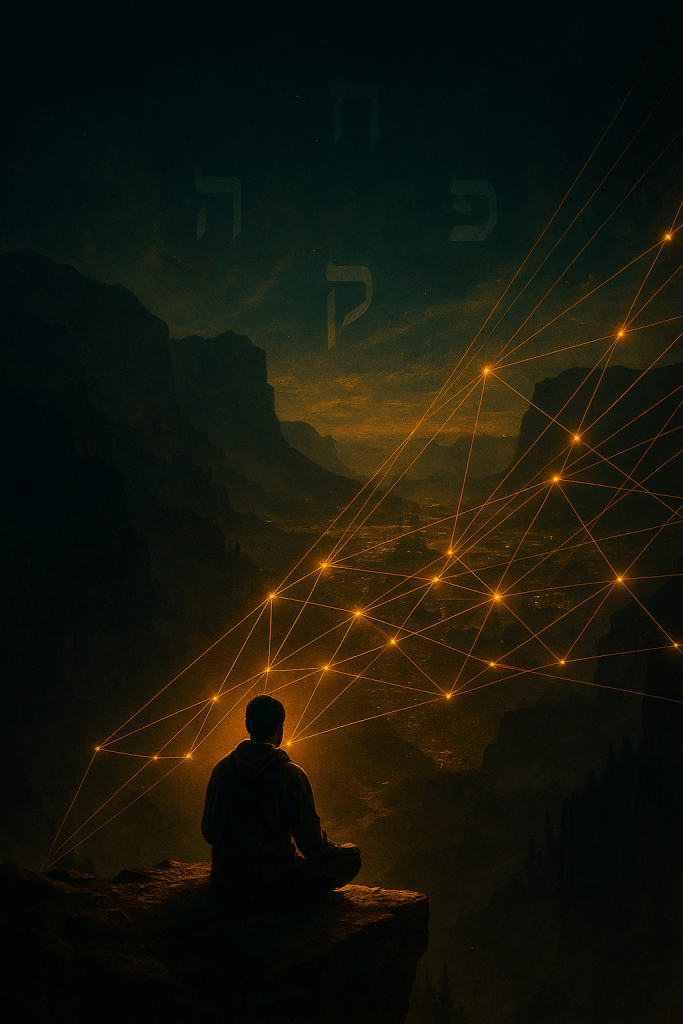
Torah, Memory, and Higher Vision Mapping
Synopsis
This essay explores the Torah concept of kefitzat ha-derech (i.e., the miraculous travel between two distant places in a brief time) as a framework for understanding remote viewing — the claimed ability to perceive distant or unseen places or events beyond ordinary sensory means — soul memory, and spiritual perception. Grounded in classical sources and kabbalistic teachings, it reveals how memory functions as a graded spiritual contraction traversing inner landscapes of consciousness. The soul’s “dynamic cartography” and vessel refinement underpin true knowledge and divine revelation, culminating in the still gaze of perfected alignment with the Creator. This work bridges traditional Torah wisdom with contemporary understandings of consciousness, offering a new paradigm of spiritual insight and inner vision.
Scientific Layer
Memory as Inner-Mind Kefitzat HaDerech
How can a person mentally see a distant place, a location they are not in? Torah answers this not with psychic conjecture but with architecture — specifically, the miracle of קפיצת הדרך kefitzat ha-derech “contraction of the path”. In its exalted form, this miracle shortens physical space. But its subtle expression occurs constantly, hidden in the act of memory itself.
From the moment the brain recalls stored information, it executes a silent contraction: not of distance, but of mental traversal. The memory signal must move across a wide and graded topology of consciousness to reach awareness. When that signal appears “instantly” in the mind, it has skipped steps, narrowed space, and collapsed time — a kefitzat derech in the world within.
This miracle occurs in degrees. A recent memory that replays with clear sensory elements — a sound, a scent, a texture — contracts more sharply than one recalled faintly. The greater the definition of these details, the more intense the contraction. Smells, colors, emotional states, and even triggering of other memories all increase the grade of the miracle. The longer a memory “plays” in real time within awareness, the higher the level of the phenomenon.
And yet it goes further.
Because the mind follows the pattern “from the most concealed to the most revealed”, memory will naturally reach for greater vividness. It will try to “complete” itself. Sometimes, that completion is spontaneous — new sensory impressions emerge within the recalled scene. This is not failure or fiction. This imaginative completion reflects the soul’s capacity, when aligned with Divine truth, to refine and complete memory, distinguishing true spiritual insight from mere fantasy. The mind adds content that was not originally recorded, yet fits coherently — a higher expression of memory’s contractive architecture.
Thus, even in everyday recall, one stands at the edge of a miracle. Memory is not just retrieval. It is movement across distances the soul alone can span.
Expanded Higher Vision
In this exalted modality of השגחת רוח הקודש hasagat ruach hakodesh “Divine inspiration”, the righteous does not merely perceive a distant scene — he enters its memory-structure and becomes aligned with its concealed imprint. For the true Torah seeker, “place” no longer refers to geographic coordinates or visual scenes. Instead, it is a spiritual imprint, a soul-state encoded within the divine spiritual structure of reality — a layered pattern inscribed in the higher realms.
The true Torah seeker’s da’at aligns not with space but with the divine pattern behind it. As the Zohar teaches: לית אתר פנוי מיניה “There is no place devoid of Him” (91b, Lech Lecha). But the mekubalim “kabbalists” go further: this does not merely imply Divine ubiquity, but reveals that all space is fundamentally a dimensional contraction from an undivided field of unity. The true Torah seeker collapses his individuated consciousness into this uncollapsed unity — into makom kodem l’makom “place prior to place” — and in doing so, he inherits access to any locus inscribed within it.
This is not astral projection, nor does it resemble the techniques of clairvoyance found in secular literature. The true Torah seeker’s neshamah travels nowhere — it resonates with the divine memory of a place, like a tuning fork suddenly vibrating in phase with a hidden note. This is the sod of reshimu — the residual impression of what once was, or what is yet to be.
And this reshimu is not passive. It holds intent, echo, imprint, and possibility. In the same way that one can vividly recall a moment so intensely it reanimates the emotions, the seeker’s retrieves a cosmic memory with such spiritual congruence that he can see, feel, and even speak from within it.
Hence, higher level-perception is not passive observation — it is active unification. The true Torah spiritual seeker does not merely see a place; he becomes aligned with its divine memory, experiencing it from within. Moreover, since memory in Torah is not limited to the past but also encompasses the future (as taught by the Ari”zal in the Sod of zachor), the seeker may perceive events yet to unfold. Not because he moves forward in time, but because he aligns with the preexisting reshimu — the higher spiritual blueprint of what is destined to occur.
This is the secret of דבר-יהו”ה היה אלי devar Hashem hayah elai “the word of G-d came to me” (Yechezkel 24:20). The word itself is not spoken — it is accessed. The prophetic word is the resonance of divine spatial memory collapsed into form, the imprint becoming a voice.
Historical Echoes of Seeing
Viewing beyond distance is not a modern concept. The Tanach records many instances where the righteous, empowered by ruach hakodesh, perceive events beyond the bounds of place, time, or concealment.
Yosef dreams of the future structure and economy of Egypt before famine arises. Elisha witnesses Gehazi’s hidden misdeed from afar. Moshe ascends and beholds the pattern of the Mishkan on Sinai. Yechezkel sees angelic beings with wheels and eyes. Daniel perceives the inner workings of empires. Bila’am, though a non-Jewish prophet, perceives the divine arrangement of Israel’s camps.
These accounts are not poetic metaphor but genuine transmissions of orientation within a prophetic spiritual topology — a layered dimension of soul-consciousness revealing real events, hidden details, or future potentials.
Such experiences are not “psychic” phenomena in the modern sense. They are not emotional guesses or paranormal talents. Rather, they are lawful, soul-based perceptions, expressed through the system of ruach hakodesh, contingent on intention, holiness, and the purity of the vessel.
To view remotely in Torah does not mean transcending the physical realm, but properly orienting within the higher spiritual planes that interact with it. The limits of space remain intact, obeyed within their holy configurations. Thus, what is seen is not imagined but oriented; not fabricated but remembered.
Remote viewing in Torah, then, is memory — soul-memory that spans space, enters concealment, and restores the alignment between seer and seen.
The Soul’s Horizon and Orientation
The soul is not a passive receiver of impressions. It is a witness, positioned along a holy path of orientation that determines how experience is registered, understood, and acted upon.
In the Torah “prophetic model”, orientation is not merely spatial or intellectual — it is fundamental. The soul must first be correctly aligned to the source of vision before it can interpret what is seen. This alignment is achieved not by intellectual clarity alone, but by faithful adherence to the divine pattern embedded in Creation.
Just as the Mishkan had an eastward-facing entrance — symbolizing the rising light — the soul, too, must face the origin of light in order to receive authentic images. When the soul turns away, even slightly, distortion begins. This is not metaphorical distortion, but structural corruption of the inner sefiratic lens — a misalignment that renders even a true vision inwardly broken.
The horizon of the soul is a metaphysical boundary, beyond which unintegrated perception becomes dangerous. Remote viewing, therefore, is not merely about seeing across space. It is about remaining oriented toward kedushah while doing so. In this light, true viewing beyond distance is possible only when the internal alignment mirrors the cosmic kav — upright, holy, and resonant with the divine order.
If orientation falters, the soul may still “see”, but the image will be false — phantasmic, inverted, or broken. This is the root of nevu’ah sheker — false prophecy not born from deceit, but from spiritual misalignment. In this way, orientation is the gateway to higher spiritual cognition, not its consequence. It is the soul’s declaration of fidelity to the Architect of Light.
The Mind’s Miracle: Memory as Inner Travel
To understand kefitzat ha-derech “contraction of the path” as a graded miracle, we begin at its most concealed register: memory. Far from a simple neurological replay, the act of remembering is a holy phenomenon of internal contraction — an instant traversal across spiritual strata within the soul. This inner movement reflects, in miniature, the outer miracle of kefitzat ha-derech revealed in the lives of tzaddikim like Yosef — not across terrain, but across consciousness.
While secular science acknowledges that memory involves complex neural signaling, it cannot account for the sudden, vivid reappearance of entire scenes, emotions, or sensations. According to Torah, this rapid emergence reveals a soul-level kefitzah, wherein the mind leaps across inner distance to reaccess a lived moment that has seemingly passed.
The more vivid the details — sounds, textures, emotions — the more intense the contraction. And when a memory plays with such clarity that it feels reinhabited in real time, the soul enacts a higher expression of this miracle, drawing the past into the present with holy immediacy.
Often, the memory refines itself mid-recall, completing missing details, clarifying textures, or linking to associated impressions. This is not imagination creating fiction — it is the soul following the pattern that revelation moves from the concealed to the revealed. In this unfolding, the memory does not just return — it expands, regenerates, and aligns with deeper truth embedded in the soul.
This is the most hidden dimension of kefitzat ha-derech: a contraction not of land or location, but of soul-space — the holy traversal of inner worlds through the miracle of memory.
Ontological Layer
The Architecture of Real Seeing
The miracle of kefitzat ha-derech — the “contraction of the path” — is most often celebrated as a physical marvel: the sudden collapse of spatial distance, allowing the righteous to traverse vast terrain in an instant.
But Torah reveals that this phenomenon is not singular. It is not limited to the dramatic or rare. It is gradated, structured, and continuous — manifesting subtly within consciousness long before appearing externally.
For in the world of sod, every miracle begins concealed. As the Ari”zal teaches, kol sod galuy ata galita — all revelation emerges in layers. Even kefitzat ha-derech adheres to this principle. It begins in the soul, as a contraction of distance not in the feet, but in the mind — not in geography, but in perception.
Thus, to truly understand this miracle, we must grasp its architecture. It is a patterned reduction of separation — a compression of thresholds — that expresses itself simultaneously across body, psyche, and spirit.
What Yosef enacted externally when he arrived at Shechem through miraculous compression, every soul enacts internally each time memory ignites instantly, when an image appears vividly without conscious summoning, or when insight arrives whole and unveiled.
These are not accidents of mental processing. They are the pshat of a higher topology: the miracle of holy contraction, operating continuously within the inner sanctum of the soul.
The Upper Worlds and the Pattern of Contraction
The Zohar speaks of the verse יהי רקיע “Let there be a firmament” not as spatial engineering, but as a cosmic stretch — a gradual and measured extension of concealed light. Its gematria, 405, mirrors exactly the front-and-back spelling אנכי נכי כי י א אנ אנכ אנכי of the word אנכי “I am”, visually indicating the grades and levels of archetypal emanation: extension within containment.
From this foundational principle emerges the very notion of distance: not absence, but framed separation. If distance itself is thus a Divine construct, then its collapse is equally so.
Kefitzat ha-derech is not a rupture in nature — it is nature’s hidden reversal.
Moreover, the gematria of the reshei tevot of the said extension אנכיאאא”א, with the kolel, totals precisely 86 — numerically equivalent to אלקים Elokim and הטבע HaTevah “The Nature”. This alignment reveals that the miracle of path’s contraction is intrinsically embedded within the laws of nature themselves. Hence, the soul’s memory of distant places is fundamentally lawful, not transgressive.
This is the pattern seen in the upper worlds: each descent of light (hishtalshelut) is governed by orderly contraction (tzimtzum), preserving the integrity of form at every stage.
What we perceive as distance is a property of Divine design — not just in the physical realm, but in the structure of soul, thought, and Divine inspiration.
Thus, when kefitzat ha-derech occurs, it does not override this pattern — it intensifies it. The reduction of space is lawful because all distance is already gradated.
The same holds for memory. Its leaps are lawful compressions of soul-space, mirroring the Divine act that structured the cosmos.
Consciousness and Distance: An Ontological Relationship
Distance is not merely physical. It is a condition of consciousness — a function of the soul’s configuration. When a person is “far” from an idea, the distance is not spatial, but spiritual. It reflects a misalignment or obstruction in the vessel.
To perceive remotely is not to bypass natural law, but to realign the soul’s orientation toward what already exists within the structure of reality.
In the soul’s ascent through the olamot, nearness to truth is measured not in meters but in devekut. Each degree of closeness is defined by resonance — alignment with the divine kav. A tzaddik does not extract knowledge from afar, but becomes transparent to the image encoded in the spiritual strata.
A true Torah seeker, even with a minimum level of Divine inspiration, however small, does not move toward a place — he ceases to distort what is already present in the reshimu.
This is the principle: what is concealed is not absent — it is untranslated. Translation depends on the fidelity of the vessel to the supernal pattern.
Contraction as Interpretive Structure
Just as sound requires a vessel to resonate, and light requires a surface to reflect, the miracle of kefitzat ha-derech requires a soul properly structured to receive its compression.
In this way, kefitzat ha-derech is not merely a spatial phenomenon — it is interpretive. It depends on the vessel’s capacity to align thought with truth.
When a person recalls a distant memory with clarity — where details appear that were not noticed before but now fit seamlessly — this is not fantasy. It is the soul participating in the miracle. The added elements are not inventions, but extensions — the imagination fulfilling its role in the mitzvah of remembering.
Imagination, when aligned with emet “truth”, assists the soul in restoring the full configuration of a past moment, as it truly was in its spiritual root.
This principle extends to prophecy. The prophet does not see “the future” in a linear, predictive sense. He accesses the pre-inscribed reshimu — the memory of that which has not yet occurred in time, but already exists in divine structure.
This is the sod “secret” of zachor: to remember forward, in accordance with the pattern encoded by the Creator.
Seeing Without Movement
In this architecture, kefitzat ha-derech emerges not as a rupture, but as a soul faculty. It is not a rare power or exotic dislocation, but a lawful alignment of inner structure. A neshamah attuned to the divine pattern of a place may perceive it without traveling. This is not metaphor — it is a real attunement to encoded holiness.
In such a state, the soul does not observe from afar, but resonates from within. It witnesses not through motion, but through structure — not by entering a new location, but by ceasing to obstruct the one already inscribed within. The miracle is not that the soul moved, but that it accessed what was latent in its design — what had never been taught or seen, but always known in its spiritual encoding.
This is the deeper miracle: not the shortening of roads, but the unveiling that the path was always internal — structured into the soul before the journey began.
Epistemological Layer
The Inner Eye and the Problem of Knowing
In Torah, the question is not merely what is known, but how it is known. Epistemology — the soul’s structure of knowing — is not a philosophical category but a spiritual architecture. To know something is not to collect data. It is to be inwardly shaped to receive its form.
This is why ruach hakodesh does not descend upon a chaotic vessel. The soul must be ordered. There must be alignment between the internal structure of the perceiver and the truth that seeks disclosure. Knowledge is not delivered as content, but revealed as light — contingent upon the precise fit between vessel and illumination.
If the vessel is malformed, the light either fails to enter or overwhelms it. This is the principle behind Shevirat HaKeilim — when light enters an unfit structure, it fractures rather than illuminates.
Thus, in Torah, true knowledge requires tikkun hanefesh. The greater the refinement of the soul’s pattern, the more precise truth can be received — undistorted, stable, and whole. Only then does the inner eye see clearly.
Sight as Structural Agreement
A higher spiritual vision is not a projection into “the future” or “a distant place”. It is the soul reaching structural agreement with the truth it is permitted to receive. Accordingly, the מתבונן mitbonen “one who contemplates with kavanah” does not summon vision — he conforms to it.
This is the law: knowledge is not taken; it is received through fitness.
The true Torah seeker is not distinguished merely by what he sees, but by his inner fidelity to the divine configuration that allows such sight. His soul becomes congruent with the vessel needed for revelation. And when that congruence is attained, perception arises — not as novelty, but as lawful emergence.
What appears sudden is in fact the disclosure of a prewritten alignment — a soul-form in covenant with the structure of reality.
Knowing as Vessels and Light
In the Torah’s epistemology, knowledge is not the acquisition of information, but the union of or and kli — light and vessel.
A vessel misshapen by ego, impurity, or imbalance will distort the light it receives. And a vessel unprepared will not receive at all. Just as physical light reveals only where it can be reflected, divine knowledge reveals only where it can dwell without fragmentation.
Thus, true knowing demands tikkun ha-kli — the inner refinement of soul-capacities to align with what is to be known.
Any degree of ruach hakodesh is never a gift that descends unconditionally. It is a condition that arises when the vessel has been sufficiently rectified to reveal what was already encoded within it.
The Role of the Vessel in Divine Knowledge
In the true Torah seeker’s cognition (i.e., the soul’s structured awareness when it receives divine knowledge through ruach hakodesh), the recipient’s vessel is the essential condition for revelation.
The Torah teaches that divine knowledge does not flow arbitrarily. It descends only to those whose vessels are refined through tikkun, purified in their middot (i.e., character attributes), and aligned in intention.
This is the foundation of ruach hakodesh — that perception depends not on desire or effort alone, but on inner structure. Where the vessel is deformed, the light cannot enter; where the vessel is whole, knowledge appears not as foreign information, but as recognition from within.
Without preparation, the soul distorts or fabricates. The impressions may feel true, but they are projections — not Divine inspiration of any level.
Thus, true knowledge is not passive reception, but the active harmonization of the soul to the divine pattern already encoded within it.
The Covenant of Knowledge and the Path of Fidelity
In the Torah’s view, true knowledge is a covenant — a hidden contract between the Divine Source and the soul.
This covenant requires fidelity, humility, and precise alignment with the divine structure.
Only when the soul walks this path of integrity can it receive knowledge that is both true and transformative.
The inner eye is not a tool of power, but a vessel of trust and obedience.
Revelation is never seized — it is granted. And only to the extent that the vessel can contain without distortion does the light of truth descend.
Soul Dynamics
The Field of Perception and the Inner Cartographer
The soul’s perception is not a static snapshot but a dynamic and unfolding field. It continuously charts the spiritual landscape of reality, not through isolated impressions or memories, but through a living matrix of spiritual coordinates — defined by resonance, intensity, and relationship to divine truth. This network extends beyond sensory data, grounding perception in the structure of holiness itself.
As the soul traverses this field, it aligns with the kav — the line of divine extension — which provides ontological direction across the layers of reality. This alignment is essential: it orients the soul’s perception toward the architecture of maaseh bereishit, enabling the traversal of vast spiritual distances without physical movement. In this light, memory, vision, and higher spiritual access are not separate faculties but manifestations of the same structural function: holy navigation within the soul’s design.
This perceptual function is active. The soul does not merely receive impressions — it refines and recalibrates them, seeking congruence with the divine pattern. The more refined the soul’s vessels, the more precise its mapping of spiritual contours becomes. With elevation in holiness, it gains access to deeper, more subtle gradients of light, discerning between true resonance and distortion.
This function is also relational. It is not the soul alone that perceives; it is the soul in fidelity with the divine order. Alignment is not self-directed but covenantal: the soul perceives because it participates in the structure of emet, not because it initiates the light.
As spiritual insight, memory, or vision arises, the soul adjusts its internal configuration to integrate these events without losing coherence. This active recalibration ensures that spiritual perception remains living — not frozen in abstraction or dogma, but responsive to the unfolding divine order.
Within this field, conventional distance dissolves. The soul does not “move” across space; it aligns with spiritual coordinates. Through this alignment, it may “arrive” at places or states beyond immediate experience. This is the secret of kefitzat ha-derech in consciousness: not the collapse of physical geography, but the contraction of inner distance through exact resonance with divine pattern.
In sum, the soul’s perceptual structure — this field of resonance, calibration, and alignment — underlies all of the true Torah seeker’s cognition, memory retrieval, and spiritual knowing. Through it, the soul navigates the infinite, maps the encoded order of creation, and participates in the unfolding of divine reality.
Structured Revelation
Yosef, Sparks, and the Design of Miracles
Higher vision is not random or formless; it unfolds through a structured design encoded in sparks that shape and sustain reality. Yosef, the archetypal visionary in the Torah, exemplifies this precision. His dreams are not symbolic images but blueprints — structured maps of spiritual and temporal destiny that reveal the hidden choreography of creation.
Within this design, the sparks — רפ”ח (gematria 288) — serve as channels through which Divine illumination flows and becomes manifest in the physical world. These sparks are not static; they interact dynamically with the soul’s ability to perceive and carry out the Divine Will. The clarity with which they are apprehended depends on the soul’s alignment and fidelity to the supernal structure.
Yosef teaches that spiritual insight arises through the ordered integration of these sparks within the soul’s internal framework. It is this precise configuration that allows the soul to transcend habitual perception and participate in the unfolding structure of revealed knowledge. Each spark corresponds to a unique modality of awareness, forming a unified geometry of soul-based perception.
The emergence of miracles follows this same architecture. What appears sudden or wondrous externally is internally structured — a calibrated outcome of spiritual preparation, ethical refinement, and inner congruence with the Divine system. The more refined the soul, the more exact its alignment, the more clearly it transmits what is Divinely encoded.
Therefore, the design of revelation is both a blueprint and a living reality — an ever-unfolding map through which the soul engages hidden dimensions of existence. This is not anomaly, but order. Not rupture, but resonance. It reveals that true miracles arise not from breaking the pattern, but from becoming faithful to it.
Epilogue
The Still Gaze and the Divine Field
The culmination of soul-vision is the still gaze — a state in which the soul, having traversed the terrain of memory, alignment, and refined perception, settles into quiet congruence with the divine field. This stillness is not passivity, but the highest expression of unified movement — where inner differentiation yields to seamless resonance.
In this state, the distinctions of space and time lose relevance. The soul does not perceive boundaries but enters the clarified presence of the Creator, where knowing and being converge. It is not a vision of something external, but the internal rest of a vessel no longer distorting what has always been there.
This is not the pursuit of revelations, but the attainment of orientation — the return to the perfected kav as traced within the soul’s inner geometry. From this alignment arises the true miracle: the capacity to behold without traversing, to know without inquiry, and to be present across the fullness of worlds by virtue of consonance alone.
Here, kefitzat ha-derech reaches its most concealed fulfillment — not in physical contraction, but in the soul’s ascent beyond fragmentation. It is the moment when the path vanishes because the destination has always been within.
Reading Journey: The Descent that Reveals Structure
- The Shadow of Eden — Cosmic concealment and dimensional fracture
- The Divine Atom — The quantum vessel of concealment
- ▶ You Are Here → Sight Beyond Distance
- Hidden Descent — Fractal emergence and divine recursion
If this exploration resonated with you, consider subscribing below or writing to share your thoughts. Tehomia exists for such alignments.
Rabbi Avraham Chachamovits
Version 1.0 • Sivan 5785 / June 2025
© 2025 Avraham Chachamovits. Licensed under CC BY 4.0
📚 Source
This page is based on content from: Chachamovits, A. (2022). Avraham BaMidbar – Kabbalistic Writings, pp. 491–494.
Available from SeforimCenter.com
 TEHOMIA