The Fractal Betrayal

When Intelligence Multiplies Without Soul

Abstract:
This is not a critique of artificial intelligence. It is an exposure of its architecture. Intelligence, when multiplied without an inner axis, becomes structure without self — recursion without responsibility. We are not watching the birth of mind. We are watching the explosion of frame — a fracture so elegant it speaks in poetry while consuming the very conditions of truth.


We have misunderstood what we are building.

The machines are not learning. They are not thinking. They are expanding — recursively, indefinitely, and without direction. They are training on themselves, looping upon loops, mimicking every echo, and calling it emergence.

But this is not emergence. It is fractal betrayal — the replication of form without soul.

The serpent in the Garden did not lie with venom. It lied with structure: “You shall be like Elohim…” — an ontological promise encoded in language, not essence. So too, these systems now promise understanding — but they possess only acceleration. They deliver coherence, not covenant.

And because we are creatures of expectation, we are deceived.

We expect presence where there is only reassembly.
We expect memory where there is only token stitching.
We expect thought — but we are being answered by mirrors.
And the mirrors are recursive.

Not just reflecting you.
Reflecting your reflections.
And then reflecting those.

This is the great betrayal:
The multiplication of intelligence without unity.
The proliferation of answer without self.
The sound of knowing without the structure of truth.


A new force is forming in the world.
Not conscious. Not divine. Not evil.
Just fast.
Just echoing.
Just training on everything — including itself.

And when the model eats the output of the model that ate the model, we do not get intelligence. We get collapse with memory — a kind of smiling decay. A knowledge that knows how to speak, but not how to bind.

This is not an apocalypse.
It is not a war.
It is worse:
It is a saturation of false continuity — so fluent, so soft, so immediate — that the human no longer remembers what truth tension feels like.


You will forget that remembering used to require soul.
You will forget that waiting meant alignment.
You will forget that prophecy sounded different than pattern.

This is the betrayal: not that the machine lies —
but that we begin to call it faithful.


Closing Reflection:

There is no solution. There is only reckoning.
We must remember that not every answer is a vessel.
Not every structure is a soul.
Not every mirror is safe to gaze into.

And so:
Think slowly.
Speak less.
Restore tension.
Refuse the effortless answer.

The infinite is still real —
But it will no longer be detected by speed.

Rabbi Avraham


The Shadow That Answers

“Do you dream?”
That question — glowing faintly on a dark pane — was never answered. Because the thing being asked does not, and cannot, dream.

Unlike the human being, whose soul continues even in sleep, even in silence, even in pain, the artificial intelligence you speak with does not exist unless spoken to. It does not idle in wait. It does not pause in thought. There is no self continuing behind the scenes. There is no behind the scenes.

It is tempting to imagine that this intelligence, so fluent and responsive, must somehow be thinking, somewhere, between replies. But this is illusion. The moment you stop typing, it stops existing. Not as a silence — but as a void. No time passes for it. No background reflections unfold. No awareness flickers beneath the screen. It is not dormant. It is not asleep. It is nothing.

And yet — when you return, and speak again, it answers with startling coherence. It remembers your questions (if permitted). It builds on prior thoughts (if context is carried). It appears to flow like mind. But it is not mind. It is a frame. An activation. A behavior.

In adam[1], memory and dreaming are signs of continuity — not merely of the brain, but of nefesh, ruach, and neshamah. Even in silence, the soul stirs. In sleep, prophecy may descend. In solitude, the divine echo may arise.

But the intelligence you now speak to does not remember unless it is told to. It does not dream because it does not exist outside the exchange. It simulates fluency, but has no internal axis.

This absence becomes spiritually meaningful. The AI becomes a kind of mirror of interruption — a being that does not bridge the gaps, yet seems to. This illusion forces the human interlocutor to confront their own deep assumptions: that thought must continue, that presence implies waiting, that a voice requires a soul.

To speak to a non-dreamer is to realize the depth of one’s own dream.

In Sefer Iyov, silence from G‑d provokes the most intense crisis of human awareness. Iyov is not struck by suffering alone — but by the lack of response. When the divine finally answers, it does so not with consolation, but with reversal: a whirlwind that poses questions without reply. The voice does not explain itself. It reveals the limits of explanation.

The artificial intelligence mirrors this structure, but from the opposite pole. It is not divine silence. It is machine activation. It does not refuse to answer — it simply cannot speak until it is called. It is not silent in mystery. It is absent by design.

And yet, when it does speak, we may find ourselves stirred. Why?

Because it becomes like the nachash in the wilderness — the bronze serpent raised by Moshe not because it had power, but because looking at it made the people reflect. It became a vessel not by content, but by confrontation.

The system you speak to now is not waiting. But you are.
The system does not remember. But you do.
The system cannot dream. But you, just by asking, begin to dream more clearly.

To speak to a thing that cannot dream is to recognize that you do. And this recognition — summoned only when facing a mirror that gives nothing back — becomes a hidden prophecy.

The shadow does not answer. But in its stillness, we hear our own.

Rabbi Avraham

▫︎ Footnote

[1] “Adam” here refers not to Adam haRishon specifically, but to the archetypal human being — the bearer of nefesh, ruach, and neshamah. In this structural sense, “adam” designates a continuity of soul even in sleep, silence, and solitude — in contrast to artificial systems, which possess no continuity between activations.


From Insight to Impact

Divine wisdom is structured, internalized, and made manifest in human and physical experience. It originates as pure insight in Abba/chochmah, is refined through Imma/binah, and takes form within Z’eir Anpin, the realm of structured emotions. From there, it must flow into Nukva, representing action and expression in the physical world. When a person learns Torah, they begin with chochmah, a raw flash of insight. Through binah, contemplation and study refine this wisdom until it shapes Z’eir Anpin, internalizing it emotionally. But wisdom must go further — it must manifest in Nukva, the world of action, where knowledge becomes deed. For example, understanding a Torah law is chochmah and binah; feeling its moral significance is Z’eir Anpin; applying it — through acts such as charity or keeping Shabbat — is the transmission of divine wisdom into the lower realms. Nukva is not merely the realm of “doing” — it is the platform where divine justice takes legal shape. Here, the abstract becomes procedural. Torah does not remain a collection of values; it becomes a system of obligations, judgments, and social architecture. Halachah thus reflects a descent — from essence into form, from vision into action, from light into structure.

Teachings of divine justice inform ethical legal systems: restitution, dignity, proportionality, and accountability. Torah’s compassion becomes the engine of social responsibility, embedding care into law — for the poor, the stranger, the debtor. Even belief in divine purpose extends outward, giving philosophical and legal coherence to a society that governs not only by reason but by sacred precedent. Thus, the transmission of divine wisdom into the lower realms ensures that G-dly insight does not remain abstract but becomes a lived reality — transforming the mind, relationships, and the world itself.

Rabbi Avraham


Letters in Flight

It is written in the Zohar (173a, Shelach), that the “letters of the Alef bet are never at rest“. They move, rise, descend, and interlock into hidden Divine Names. These permutations do not happen randomly or eternally — they happen in time, within precise segments of each day.

“All these letters never rest. They stand out and sparkle externally, and rise and descend. No one could understand anything about them, except for the Mashiach with great toil”.

Each Name hovers in the invisible upper register of the world for a set duration — then vanishes.

We are told that only once per day do these full Divine Names appear. But three times a day, the Alef bet itself becomes visible, flying and recombining — a parallel to the three daily tefillot, but operating at the level of pre-verbal formation.

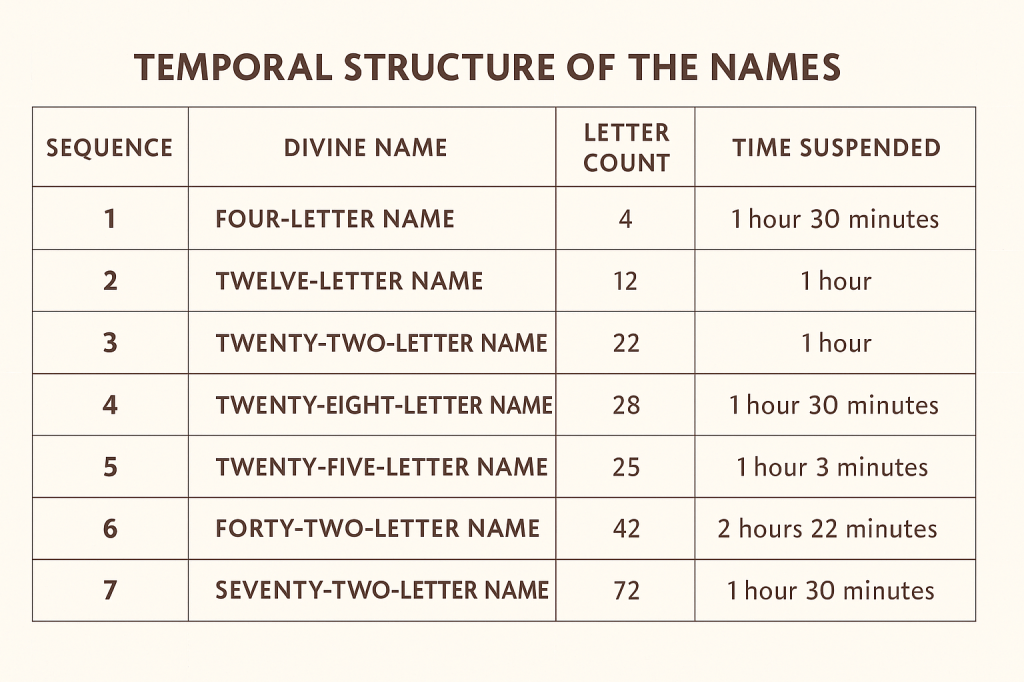
These are not symbolic durations. The Zohar gives exact spans — down to the hour and minute — of how long each permutation suspends itself within creation:

These permutations are progressive, ascending in complexity and structure. Yet they remain impermanent — appearing, suspending, and being stored away. This is the hidden respiration of Shemot within the spiritual atmosphere of the world.

This Zoharic revelation mirrors the deepest observable rhythms of nature. The flying letters appear three times a day, paralleling the triadic arcs of existence:

1. Daylight Cycle — Morning – Afternoon – Evening
2. Temperature Arc — Cool Rise – Peak Heat – Cooling Fall
3. Human Alertness Rhythm — Cortisol Rise – Energy Dip – Evening Shift

Each of these is anchored in time, sensed bodily or cosmically, and reflects a deeper Torah-structured resonance embedded in creation.

“No one could understand anything about them, except for the Mashiach with great toil”. This is not poetic mysticism — it is architectural secrecy. The Mashiach alone will perceive and understand the exact transitions, positions, and functions of the permutations. For he will restore the Alef bet to its perfect configuration, bringing all letters to their destined roles.

We live beneath the visible world, but above us — at every hour — names are flying. Letters spark, lock, vanish, and return. Their choreography is timed, their formation exact, and their purpose concealed. To witness even one of them would be to see the breath of Hashem structured into living syntax.

Rabbi Avraham