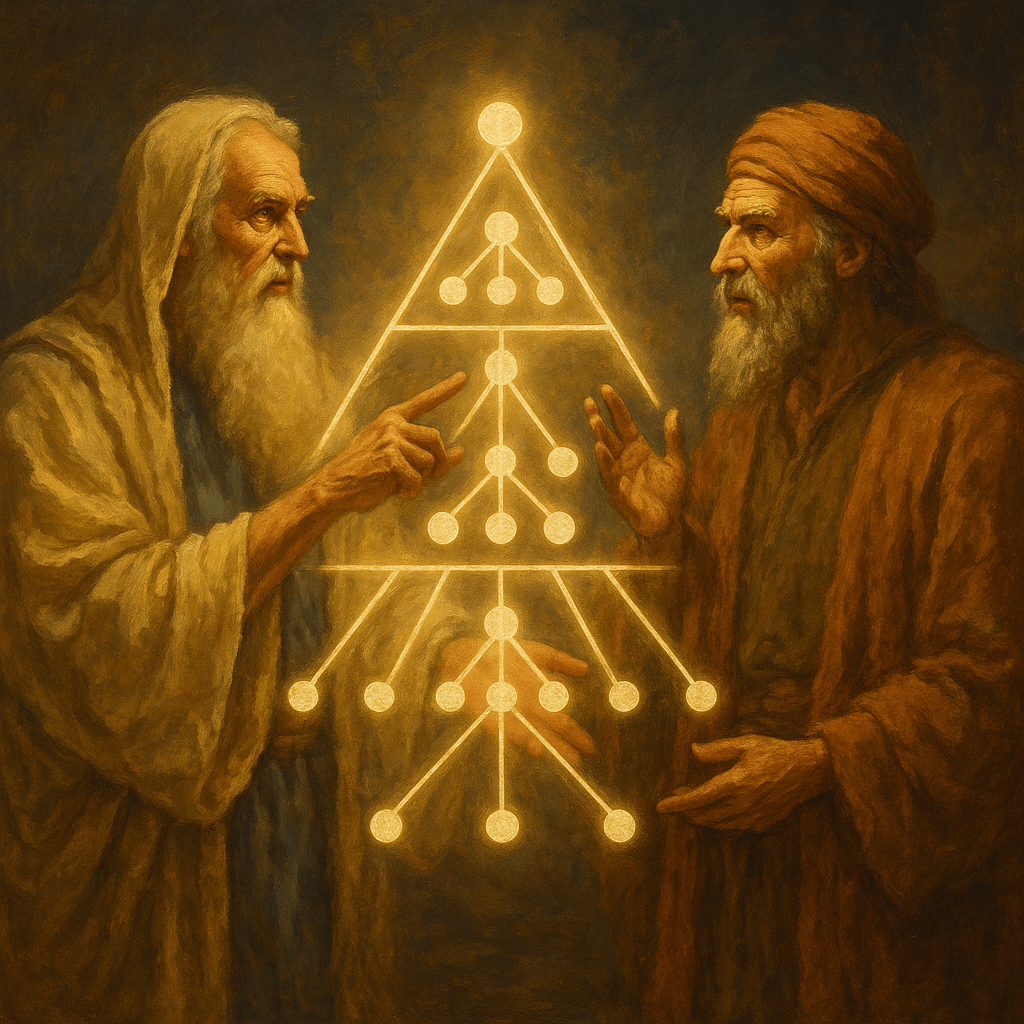
Torah Language is Ontological — Science is Still Catching Up
I. The Problem Yitro Solves
The Torah embodies a unique epistemological model. It is not merely a narrative or a set of laws, but a structure of mind that resonates throughout creation, forming the blueprint upon which reality itself unfolds. Thus, to approach Torah is to approach the architecture of thought — not as a constructed belief system, but as the pre-existent order from which all structure derives.
Because Torah knowledge is structured, any interaction with it reveals not just information but architecture. And to see that architecture in motion, we must examine a precise moment where structural truth is not invented but uncovered. This brings us to the episode of Yitro, Moshe’s father-in-law. The narrative that follows is not merely historical; it is ontological. It reveals the template of Divine law transmission embedded in the soul of the Torah.
Yitro comes to Moshe and observes him administering judgment from morning until evening, alone. He immediately recognizes the unsustainability of Moshe’s method and presents his critique with precise clarity: לא טוב הדבר אשר אתה עשה נבל תבל גם אתה גם העם הזה “The thing that you do is not good. You will surely wear away, both you and this people” (Shemot 18:17). From this moment, Torah unveils a critical law of mind: that knowledge, if Divine, must flow through structured hierarchy — or else it collapses.
Moshe, embodying the highest prophetic insight, nonetheless accepts and implements Yitro’s organizational advice. He establishes a judicial framework — leaders of thousands, hundreds, fifties, and tens — to handle lesser cases, reserving only the most complex for himself. This act of delegation is not a concession to exhaustion. It reveals that Torah’s truth flows downward in scaled gradients — each level a calibrated vessel for clarity. This model is not just efficient — it is metaphysical. It mirrors the descent of Divine light through sefirotic layers, from unity into multiplicity, from panim el panim “face to face” into concealment and gradation.
But how did Yitro gain the insight to perceive this? Why was he the one to discern the embedded structure of judgment?
The answer begins with his hearing. The Torah says: וישמע יתרו Vayishma Yitro “And Yitro heard” (Shemot 18:1). But was Yitro the only one who heard of G-d’s wonders? Did not the nations tremble: שמעו עמים ירגזון חיל “People heard, they were afraid” (Shemot 15:14)? Indeed, all heard — but Yitro alone responded. This is the cause: unlike others who merely received sound, Yitro absorbed signal. The effect: he renounced idolatry, accepted the Holy One, and aligned himself with the true source of order.
This inner movement triggered a spiritual elevation. Through his total rejection of falsehood, Yitro ascended in kedusha “holiness”. The Torah encodes this ascent with exactitude: the reshei tevot “initial letters” of the verse וישמע יתרו כהן מדין חתן משה את כל-אשר עשה אלהים למשה ולישראל עמו כי-הוציא יהו”ה את-ישראל ממצרים (ויכמחמאכאעאלועכהיאימ) “Now Yitro, the priest of Midian, Moshe’s father-in-law, heard of all that G-d had done for Moshe, and for Israel His people, how that the L-rd had brought Israel out of Egypt” (Shemot 18:1) yields a gematria of 409, the exact value of kedusha. This is not poetry, it is structure.
And here the Torah reveals a deeper law: that spiritual elevation enables intellectual perception. Having been the chief priest of idolatry in Egypt, Yitro’s radical inner reversal not only lifted him in holiness — it expanded his cognitive structure. This is the vertical axis of knowing.
Indeed, kedusha does not merely purify — it transforms. In atbash cipher, kedusha becomes דקבצ, which when reconfigured (tzeruf) forms בצדק — “with righteousness”. This teaches us that holiness contains righteousness, just as vertical insight encloses the horizontal plane. Righteousness governs the world of daily justice (binah, da’at), but kedusha introduces chochmah — a higher wisdom that is not analytic, but luminous.
The result is a fusion: Yitro receives mochin d’gadlut, the expanded consciousness of chochmah, binah, and da’at. Only through this holistic elevation — vertical and horizontal — could he offer counsel to Moshe, the greatest prophet. His advice is not strategy. It is disclosure of what was already true.
II. Language as Ontological Vessel
The moment Yitro perceives the judicial structure; he also perceives its language. For in Torah, law is never separate from language — structure is expressed through the word. The architecture of judgment flows through linguistic channels, not merely social systems.
This is the ontological power of Torah language: it does not describe what has been discovered — it reveals what is. Its vocabulary is not empirical, but foundational. Each term is aligned with a level of reality, a specific resonance of spiritual structure. This is why Yitro’s ascent leads not just to new insight, but to the perception that Torah’s language never needs revision — it needs revelation. This directness of Torah language — its ability to name reality at its root — becomes even more striking when we contrast it with the reactive, observational language of science.
By contrast, scientific language is reactive. It emerges after a phenomenon is observed, analyzed, and debated. Scientific terminology attempts to reverse-engineer realities that have always existed — but lacked verbal capture. The result is a knowledge system always catching up to what Torah already articulates in root form.
III. Reactive Vocabulary: Science Always Lags
Nowhere is this dynamic more evident than in the evolution of scientific vocabulary. Because science lacks an ontological language, it must invent names for structures it only later discerns. Its linguistic acts are delayed responses to being.
- Quarks — subatomic entities theorized to be the fundamental building blocks of protons and neutrons — had no observable form and required invented names to express their strangeness. The labels given (charm, top, bottom) reflect not precision, but the collapse of referential language. Torah, by contrast, speaks of creation as structured descent — from infinite light to finite vessel — without relying on physical instruments or empirical data to prove its reality.
- Dark Matter and Dark Energy — placeholders for unseen forces inferred from gravitational and cosmological behavior. They are mathematically necessary, yet ontologically undefined. But Torah speaks of ayin “nothingness” that precedes yesh “something”. It is not darkness in the absence of knowledge, but darkness as the container of light.
Science is brilliant but it is posterior. It builds vocabulary to map a void. Torah names from the origin. The difference is not merely in process — it is in metaphysics.
Science builds telescopes to glimpse what Torah names from within.
IV. The Hierarchy Was Always There
And just as Torah names from the origin, it structures from the origin as well. The system speaks from the same root that judges — structure and sentence are one. Language and law emerge from the same primordial source.
Yitro’s suggestion was not a creative innovation. It was the articulation of a structure embedded in Torah’s DNA. Tens report to fifties. Fifties to hundreds. Hundreds to thousands. Thousands to Moshe. This is not a political system — it is a cascade of light through measured vessels.
Yitro perceived that Divine transmission must occur in scaled descent. Each level filters the light, rendering it digestible. This is how Moshe remains the apex but does not become the bottleneck. The structure is fractal. The pattern is eternal.
V. The System Always Precedes Language
This leads to the most fundamental revelation of all: Torah is not made true by experience. Experience conforms to Torah.
Yitro’s realization confirms this. He did not create a new structure. He aligned with what was already written into the system. And that is the entire nature of Torah — it does not evolve. It reveals. Scientific insight, judicial reform, structural innovation — when true — are not novelties. They are returns.
Because in Torah, every form precedes its appearance. Every law is older than its codification. Every word is older than its utterance. And every insight — like Yitro’s — is not brilliance. It is alignment.
Yitro vividly reveals Torah’s judicial blueprint — dispute hierarchy, nuanced delegation, and communal harmony through structured judgment — illuminating the sacred architecture upon which Jewish communal life thrives.
If this exploration resonated with you, consider subscribing below or writing to share your thoughts. Tehomia exists for such alignments.
Rabbi Avraham Chachamovits
Version 1.0 • Tammuz 5785 / July 2025
© 2025 Avraham Chachamovits. Licensed under CC BY 4.0
📚 Source
This page is based on content from: Chachamovits, A. (2022). The Kabbalah of Celestial Influences pp. 28-31.
Available from SeforimCenter.com
 TEHOMIA