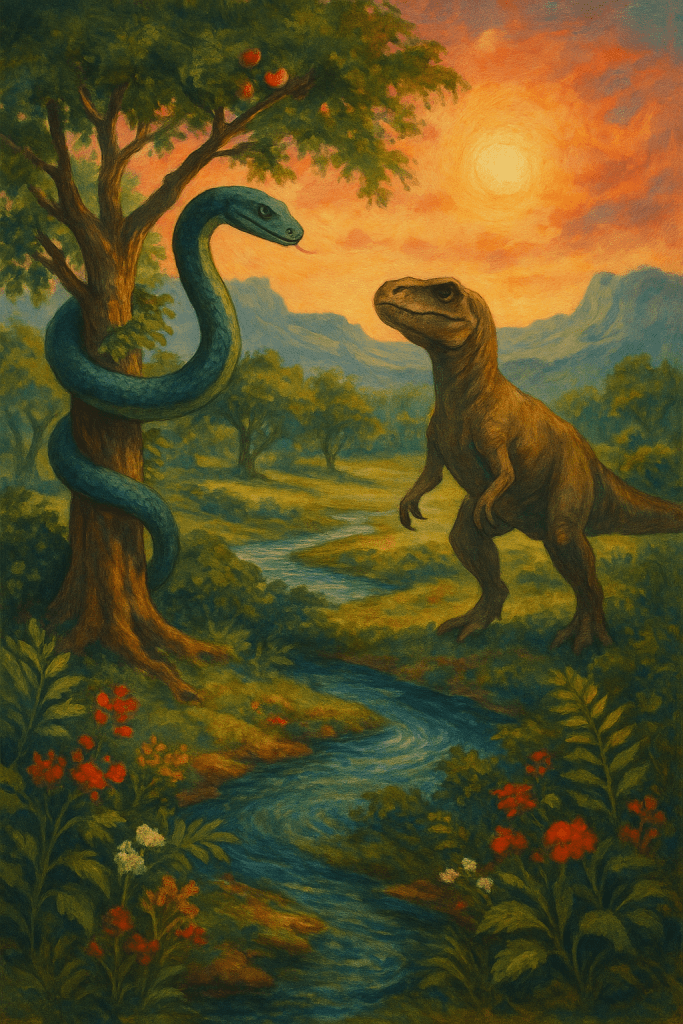
Pre-Adamic Ruins and the Fossilized Fire of the Serafim
This essay presents a Torah-rooted interpretation of paleontological data through Kabbalistic categories, midrashic framing, and structural gematria. It is not a scientific treatise, but a spiritual architecture of biological remnants as echoes of angelic descent and cosmic tikkun.
SCIENTIFIC LAYER
The fossil record presents an overwhelming picture of prehistoric life on earth: vast, violent, and highly varied. Enormous reptilian species appeared and disappeared across multiple geological epochs. According to conventional science, these events reflect long evolutionary processes, sudden extinction events, and dramatic environmental shifts. But in the light of Torah, another pattern emerges — one where these creatures are not mere results of randomness or natural selection, but consequences of angelic rebellion, divine orchestration, and spiritual descent.
Torah sources state that each divine “day” of Creation established a new ontological layer of reality. These were not simple chronological days, but distinct spiritual configurations, each introducing unprecedented forces into the cosmic order. With each day, what came before was spiritually invalidated, creating a pattern described by the Midrash: “The Holy One, blessed be He, created worlds and destroyed them… until He created this one [of our current reality] and said, ‘This one pleases Me’” (Bereshit Rabbah 9:2). This repeated creation and nullification mirrors the scientific observation of successive waves of extinction and speciation — yet it is not random. It is intentional deconstruction and reconstruction of metaphysical structure.
On the fifth divine day, Torah reveals that angelic entities were created. Among them, Samael, the Accuser, initiated a celestial rebellion and descended to the material plane with numerous angelic forces. These entities, known in Torah as serafim and nechashim “fiery serpents” and “burning ones”, clothed themselves in material substance to survive the coarse nature of this world. As they passed through descending strata of spiritual worlds (olamot), their original fiery essence was dulled and densified — until, reaching this physical plane, they emerged with enormous size and primal force.
This spiritual descent had physiological consequences. In the ancient layers of sediment and stone, we find precisely such beings — massive reptilian lifeforms whose fossilized remains dominate the prehistoric record. Torah identifies them as tanninim gedolim, “the great sea-monsters”, whose bodies match the conditions required to house a fallen angelic consciousness: robust, instinct-driven, yet animated by a primal trace of higher fire.
✦ Angelic–Fossil Correlation
• Serafim and tanninim gedolim are described as fallen intelligences housed in massive reptilian bodies
• These beings collapsed into material density and left behind visible remnants
• The fossil record is thus interpreted not as biological history, but as the sealed evidence of cosmic disobedience
• These fossils belong to a non-human pre-Adamic era, defined by spiritual failure and material residue
• Torah does not regard them as evolutionary ancestors, but as echoes of an erased world
From the standpoint of modern paleontology, the timing and placement of massive reptilian life corresponds with early environmental conditions involving high oxygen content, dense humidity, and a lack of human presence. From the standpoint of Torah, these conditions were not merely physical but spiritual — suitable to host the descent of angelic forms into biological vessels. Thus, the so-called “dinosaurs” were not proto-human beasts but fallen, solidified forms of supernal consciousness, remnants of a divine cycle of creation, judgment, and concealment.
SOUL DYNAMICS
The Diminishment of Angelic Consciousness in Behemot Form
The serafim, in their celestial nature, are entities of fire — burning awareness, will without obstruction, intelligence unbounded by matter. Their essence is not instinct but divine execution; they serve the upper throne and do not question their mission. Yet in their rebellion, as led by Samae”l, they descended through the ordered rungs of seder hishtalshelut — the chain of descent of the spiritual worlds — shedding luminosity with each fall.
This descent was not metaphor. It was embodiment. To survive in the realm of עשיה גשמית Asiyah gashmit, the physical world, these beings had to invest their fiery selves into vessels of equal density and resistance. Thus were formed the tanninim gedolim, the great serpents and sea-monsters, whose bones lie scattered in the earth’s strata. Their emergence was not biological evolution but ontological collapse. The soul of the angel passed through constriction after constriction until what remained was rage, territorial instinct, and scale-bound violence — a memory of fire buried in flesh.
Their form reflected this. Gigantic, armored, built for dimensions their world no longer required. They did not evolve to survive — they emerged to contain. The divine fire that once obeyed without deviation now pulsed through sinew and bone, misaligned with purpose, driven not by retzon elyon but by a distorted echo of their original mission.
Their existence was permitted not as punishment but as containment: to house a fire too volatile for the heavens and too primal for man — until the soul of history would be ready to process it.
This is the sod “secret” of corporealization. When a spiritual force refuses its place in the upper worlds, it must find configuration below. But below, purpose does not disappear — it warps. The seraf becomes serpent. The fire becomes fang. The song becomes roar.
And yet the Torah does not entirely cast these beings out. It encodes them. It calls them nechashim serafim, and not simply behemot. It connects them, subtly, to the Edenic memory by the gematria of בגן עדן b’Gan Eden “in the Garden of Eden” is 179, the same as for הנחשים השרפים “the nechashim, the serafim“. It hints that their terror, size, and strength were not merely punishment, but containment. In the garden’s vast precincts, these forms moved — not as symbols of chaos, but as signs of transmutation.
Moreover, the Gemara teaches: כל העולם כולו מתמצית גן עדן הוא שותה “The entire world drinks from the remnant waters of the Garden of Eden” (Ta’anit 10a). The mispar siduri of this phrase is 358 — the same as נחש “serpent”. This reaffirms that the ancient world’s nourishing structure included the nachash, not as a later contaminant, but as a primordial presence. These beings, embedded in the architecture of the pre-Adamic earth, were not interruptions — they were structural. They belonged to the system that nourished, warned, and prefigured the coming of man.
In the soul-language of Torah, this teaches that rebellion has consequence, but not annihilation. Even the highest can fall into materiality, but the trace of origin remains. These beings walked in a world before Adam, not as rivals, but as remnants — spiritual presences now concealed in scales, tasked to burn without light.
PROPHETIC ARCHITECTURE
The Pre-Adamic Landscape and the Geometry of Ruins
The Torah’s cryptic allusion to repeated creations — “He created worlds and destroyed them” — is not aggadic embellishment but architectural disclosure. Each divine day did not merely introduce new elements but established entire configurations of existence. What is “destroyed” in this framework is not material alone, but spiritual alignment. Each successive creation replaces the prior geometry of being with a new one, leaving behind the traces of the invalidated structure like scaffolding never fully dismantled.
This becomes the prophetic architecture of our world: a composite built atop the debris of earlier divine expressions. The primeval reptiles, those “great serpents,” were not evolutionary accidents but artifacts of a superseded reality. They are the fossilized glyphs of a pre-Adamic world, where celestial intelligences once governed now-buried structures. Their anatomical extremity—massive skulls, clawed limbs, armored tails — is not incidental. It encodes the excessive force needed to anchor fallen angelic essences in a domain unsuited to their being.
Thus, the paleontological record functions as prophecy-in-reverse. It reveals, in stone and skeleton, the afterimage of prior worlds. These are the ruins of angelic descent, silent witnesses of what happens when holy fire deviates from its assigned circuit.
The verse ויברא אלקים את התנינים הגדלים “And G-d created the great sea-monsters” is not mere zoological notation. It is an architectural insertion, a moment where the Torah punctures our chronology to mark the intersection of rebellion, form, and spatial displacement. These creatures were not just created — they were assigned. Placed within the widened dimensions of that early Gan Eden, they served as dynamic containments, holding within them the echoes of failed missions.
This explains why, in the Torah narrative, the account of the tanninim appears before the creation of man. The landscape into which Adam would later be placed was already layered with precedent. The world he inherited was not clean, but sedimented. It bore the imprint of earlier realities — some angelic, some chaotic, all converging into the background architecture of human responsibility.
The prophetic consequence is this: our current world is not isolated. It rests atop strata of meaning, failure, and transformation. The presence of monstrous remains beneath our feet is not evolutionary noise, but theological signal. It warns and reveals that disobedience reshapes space. That rebellion leaves behind skeletons. That even angels, when misaligned, must be housed in forms vast enough to bear their fall.
One day, even those bones will speak when the world is ready to interpret the grammar of its buried angels.
THE NACHASH RACE
Dominion, Destruction, and the Techno-Spiritual Legacy Before Adam
After the collapse of the serafic reptilian forms and the upheaval of the primeval world, a new dominion emerged — not of man, and not yet of Eden, but of the Nachash race. These beings survived the extinction of the giant reptiles and assumed supremacy over the fragmented, post-cataclysmic earth. Theirs was a reign not of brute scale but of cunning, accumulation, and proto-technological ascent.
This period — rarely spoken of—preceded the Adamic age and is hidden beneath layers of Torah and geological metaphor. It was a time when pre-Adamic humanoids existed under the rulership of the Nachashim, whose knowledge and capabilities far exceeded their subjects. The Zohar and Sages preserve cryptic echoes of this: serpents with minds, purposes, and desires not yet bound by the curse of Eden.
This dominion did not arise in tranquility. According to secular science, approximately 66 million years ago, a mass extinction event terminated the Cretaceous period (roughly 145 to 66 million years ago, accoring to secular science). Alongside the well-known asteroid theory, scientists also note the eruption of the Deccan Traps, a colossal volcanic province in India. The Torah hints at the spiritual understructure of these converging devastations. Astonishingly, the gematria ayak bakar of נחש “serpent” and the mispar musafi of הר געש “volcano” both equal 583. This is not a numerical coincidence, but a sod-level signal: the Nachash is linked intrinsically to upheaval, to tectonic fire, to earth’s volcanic judgment and renewal.
Even after this planetary trauma, the Nachashim remained. Their rule extended across the liminal generations before Adam. Their activities — cloaked in legend — are remembered by the Sages with curious reverence. As taught in the Talmud, Sanhedrin 59b:
“Woe for the loss of a great servant. For had the serpent not been cursed, each Jew would have had two good serpents — one to go north and one to go south — to gather for him precious gems and pearls”.
This is not allegory. It is encoded testimony. The Sages saw, through ruach hakodesh, a pre-cursed reality where the Nachash gathered materials of technological consequence. Their role was not only to rule but to extract, carry, and construct. These were not wild beasts — they were functionaries of a different kind of civilization, one that mined divine elements and moved them along networks of spiritual need.
Hints of this deeper function appear again in the Talmud, Bava Batra 75a, where the Midrash describes the canopy of Adam in Eden as being adorned with every precious stone:
“Carnelian, topaz, emerald, beryl, onyx, jasper, sapphire, carbuncle, smaragd, and gold”.
The complete verse אדם פטדה ויהלם תרשיש שהם וישפה ספיר נפך וברקת וזהב “every precious stone was your covering, the ruby, the topaz, and the diamond” (Yechezkel 28:13) has a mispar katan mispari equal to 7, the same as for נחש. The implication is that what was once gathered by the Nachash later adorned Adam — an inheritance of spiritual technology repurposed for man, now enclosed in kedusha.
Even deeper, the verse in Bereshit 2:12 tells us:
“And the gold of that land is good, there is bdellium and the onyx stone”
Its gematria katan is 131, the exact value of סמא”ל, the arch-root of the Nachash. Here, the Torah quietly unites gold, serpent, and Eden—all in one encoded verse. The presence of the Nachash is not foreign to Eden — it is buried within its beauty. The serpent’s memory lingers in the very stones Adam was meant to inherit.
But the legacy of the Nachash was sealed off. When Adam entered the world, a new order was needed. The dominion of serpentine intellect was no longer appropriate for the new vessel of free will. And so destruction came again — spiritual, if not geological. The ruling race was exiled, cursed, and silenced. What remained was fossil, whisper, and gem.
Yet the remnants of that world still glint beneath the surface: coded in verses, sealed in stones, echoed in volcanos. The Nachash once ruled a world without Torah. Now the Torah tells of that world in whispers only the wise can hear.
If this exploration resonated with you, consider subscribing below or writing to share your thoughts. Tehomia exists for such alignments.
Rabbi Avraham Chachamovits
Version 1.0 • Sivan 5785 / June 2025
© 2025 Avraham Chachamovits. Licensed under CC BY 4.0
📚 Source
This page is based on content from: Chachamovits, A. (2022). Avraham BaMidbar – Kabbalistic Writings, pp. 371–373.
Available from SeforimCenter.com
 TEHOMIA