
Reading the Soul Between the Lines
Torah-Forensic Psychology and the Discernment of Inner Structure through Language
Introduction – When Words Reveal the Soul
There is no such thing as “just words.” Every sentence we write ̶ every greeting, every apology, every explanation ̶ is a revelation of the self. This is not metaphor. It is sod.
In Torah, the act of speech (dibbur), and its residue in written form (ketivah), is a vessel that channels the nefesh often more truthfully than the writer intends. The shape and structure of a message betray impulses of ego, humility, doubt, conviction and more. Even the choice of a single word can signal alignment with Divine purpose or concealment of inner tension.
What if there were a way to read these words not merely semantically, but structurally ̶ to discern character, intention and spiritual orientation? What if a method grounded in kabbalistic categories could expose distortion, projection or genuine clarity through tone, pacing, formatting and word-choice?
This is that method. Drawing on the ten Sefirot as diagnostic channels, we offer a Torah-anchored system to map every written exchange. By tracking distinctive “axes” of opening, authority, balance and closure, the reader gains a forensic lens ̶ an x-ray of the soul in every line.
The Origin of This System
The method presented here was not invented. It emerged over time, through sustained written exchange with diverse souls ̶ seekers, students, critics, pretenders, and kindred minds. From a single test case, it grew, shaped by successive examples of deep inquiry and bright misfires alike.
Through these encounters, patterns began to crystallize. Each message ̶ whether a humble inquiry, a self-inflated assertion, or a fearful plea ̶ carried distinct structural signatures. Over years, it became clear: the shape of a written message is an x-ray of the soul’s condition.
This x-ray reveals more than content. It discloses configuration: where a person bends truth, which impulses they prioritize, how they navigate authority, and whether they seek genuine transmission or mere performance.
With time and ever-broader data ̶ initial test emails, followed by extended student–Rebbe exchanges, and even challenging cold-call requests ̶ these observations were distilled, layered, and rigorously mapped onto Torah categories. At its core lies the Tree of exposure, built on the Ten Sefirot, each serving as a diagnostic channel to probe the nefesh in every line.
The Sefirotic Map of Written Disclosure
Beneath every email, comment, or letter lies a hidden structure ̶ an energetic fingerprint of the nefesh. By mapping our ten diagnostic axes onto the Ten Sefirot, we transform each line of text into a radiographic field of spiritual exposure.
Each Sefirah acts as a diagnostic channel:
- Keter (Opening Gate): the crown of first words, revealing intent and reverence.
- Chochmah (Ego Displacement): flashes of self-orientation versus true teacher-centered humility.
- Binah (Spiritual Register): depth of Torah vocabulary versus mere decoration.
- Chesed (Length–Content Ratio): generosity of speech balanced by disciplined brevity.
- Gevurah (Authority Signal): the integrity of one’s chain versus self-appointed prestige.
- Tiferet (Rational–Emotive Balance): harmony between mind and heart.
- Netzach (Boundary Awareness): respect for limits versus intrusion.
- Hod (Conspiracy Markers): submission to evidence versus paranoid totalizing.
- Yesod (Control Language): openness of inquiry versus directive coercion.
- Malchut (Exit Tone): the crown of closure, reflecting humility or pride.
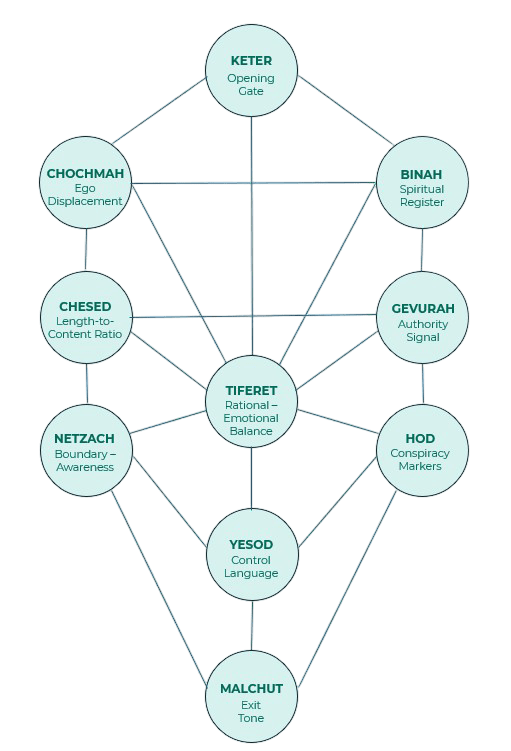
The 10 “Diagnostic Axes” below are each aligned with a Sefirah ̶ the spiritual channel it most directly expresses or distorts. The written word becomes the diagnostic field through which the configuration of the soul is revealed, line by line. Each axis is a distinct forensic vector. Each is a point of entry for the trained reader. Together, they become a coherent Torah-Forensic System.
I. Foundations
The soul writes even when the hand thinks it does not.
Every message, especially the first contact, is not just communication. It is exposure.
This method decodes that exposure using Torah principles, not secular psychology.
1. Speech and Writing as Revelation
- כל הנביאים נתנבאו בלשון בני אדם ̶ All prophets speak in the language of man, but the Divine content breaks through.
- Just as dibbur/speech reveals the penimiyut halev/innerness of the heart, written words ̶ stripped of tone or face ̶ reveal even more.
- The reshimu/residue of the nefesh is found not only in what is said, but how: structure, pace, emotional gradient, and word choice.
2. This Is Not Graphology
- This system does not read handwriting, but soul-structure through textual formation.
- It draws from Torah categories: clarity, humility, da’at, lashon, shoresh, and tziyur hadibbur/formation of speech (i.e., the way an utterance takes on).
- It is a forensic-diagnostic tool for correspondence discernment, especially critical in online Torah transmission today.
| Icon | Axis | Cue |
|---|---|---|
| 🪟 | Opening Gate | Tone of first line: respectful ↔ entitled ↔ hostile ↔ over-warm |
| 🧍 | Ego Displacement | Centered on self ↔ centered on teacher/learning |
| 🔮 | Spiritual Register | Genuine Torah usage ↔ decorative mysticism ↔ casual “consumer” tone |
| 📏 | Length–Content Ratio | Substantive brevity ↔ rambling overuse |
| 🧑🏫 | Authority Signal | Clear chain-of-transmission ↔ self-appointment |
| ⚖️ | Rational–Emotive Balance | Harmony of logic & emotion ↔ imbalance |
| 🚧 | Boundary Awareness | Respect for conversational limits ↔ intrusion |
| 🕵️ | Conspiracy Markers | Evidence-based claims ↔ hidden-knowledge rhetoric |
| 🖋️ | Control Language | Inquiry tone ↔ directive/coercive tone |
| 🏁 | Exit Tone | Humble close ↔ defensive sign-off |
II. The 10 Diagnostic Axes
The beauty of the diagnostic system is not in its structure alone, but in its sodic coherence ̶ the seamless binding of Sefirah and behavioral pattern through Torah categories. Without this inner tether, the Tree would remain a metaphorical overlay. Each diagnostic axis is a vector of spiritual exposure. The trained eye can see the nefesh orientation by tracking these signals.
Each sefirotic category reflects a distinct inner orientation ̶ a spiritual angle through which the soul channels its original perception into language. These are not merely expressions of will (Keter), flashes of undivided insight (Chochmah), or acts of structured cognition (Binah). They are not limited to emotional expansion (Chesed), inner constraint (Gevurah), or calibrated harmony (Tiferet). Nor are they reducible to persistent drive (Netzach), structured submission (Hod), faithful transmission (Yesod), or embodied manifestation (Malchut). Rather, they are windows into what the soul prioritizes, suppresses, exaggerates, or reveals ̶ each one an encoded trace of its will, light, and vessel in motion.
1. KETER (Opening Gate)
How a message opens reveals its intent
Keter corresponds to the superconscious realm ̶ the concealed will and originating impulse behind all expression. It is the generator and activator of the entire chain of Sefirot, containing within it the ultimate goal and the inner drive to realize it. Just as the will of a person gives rise to all other faculties ̶ thought, planning, action ̶ so too does Keter initiate the flow toward revelation of the Infinite Light at every level of reality. In writing, this corresponds to the opening line: the point of origin that encodes the writer’s true intent. Whether respectful, manipulative, warm, or abrupt, the opener reveals not only tone but the direction of the soul. The Opening Gate is thus the Keter of the message — the concealed beginning from which all other signals unfold.
• Respectful (The writer’s first motion is reverent intent ̶ recognizing the other’s presence and role. The message opens from a place of humility. This is a Keter orientation toward alignment with above).
- Polite greeting that honors the recipient’s role.
- Example: “Dear Rabbi X, thank you for considering my profile…” (shidduch résumé)
- Why it matters: Sets a tone of humility and genuine deference, inviting open-hearted exchange.
• Entitled (The writer’s first motion is demand ̶ centering their own need without spiritual attunement. This is a Keter misalignment, where the will ignores the other).
- Skips pleasantries to demand attention immediately.
- Example: “Let me cut to the chase…” (public forum post)
- Why it matters: Signals the writer expects value or answers without offering respect in return.
• No greeting (The writer’s first motion is absence ̶ as if the presence of the other is irrelevant. This reflects a blocked Keter, lacking conscious intention toward relationship).
- Begins mid-stream, as if the recipient’s time and title need no acknowledgment.
- Example: “Looking for Sefirah from ga’avah/pride and ka’as/anger ̶ does the Rav know?” (meeting request)
- Why it matters: Implies presumptuous familiarity and a lack of reverence.
• Disguised hostility (The writer’s first motion is masked aggression ̶ a will cloaked in offense or defense. This reflects a distorted Keter drive rooted in control).
- Opens with a challenge or justification rather than a salutation.
- Example: “I don’t need to explain, but you should know…” (halachic query)
- Why it matters: Puts the recipient on the defensive from the first word, eroding trust.
• Over-warm (The writer’s first motion is exaggerated sweetness ̶ will softened into performance. This reflects a confused Keter, where clarity of purpose dissolves into affect).
- Excessive flattery that feels performative.
- Example: “My dear sweet teacher, your wisdom lights my very soul…” (student feedback note)
- Why it matters: Can mask insecurity or manipulation, making sincerity hard to discern.
• Defensive apology (The writer’s first motion is fear of rejection ̶ will collapsing into self-justification. This is a hesitating Keter, obscured by inner doubt).
- Leads with self-justification before any greeting.
- Example: “Sorry if I’ve caused any discomfort…” (follow-up apology)
- Why it matters: Draws focus to the writer’s anxiety rather than the substance of the ask.
• Corporate curt (The writer’s first motion is transactional ̶ will expressed without warmth or relationship. This is a Keter locked into utility, not soul presence).
- Abrupt business-style opener.
- Example: “I require immediate access to my account ̶ fix it now.” (customer support ticket)
- Why it matters: Signals transactional mindset and low regard for relationship.
• Formally distant (The writer’s first motion is cold distance ̶ will guarded behind impersonal formality. This reflects a Keter encased in externality).
- Ultra-formal without warmth.
- Example: “To whom it may concern: Please find my résumé attached.” (job application)
- Why it matters: Creates a barrier, suggesting an impersonal or bureaucratic exchange.
Diagnostic prompt: Does this opener seek genuine clarity (light) or validation (recognition)?
2. CHOCHMAH (Ego Displacement)
What ̶ or whom ̶ is at the center of the message
Chochmah is the primordial flash of insight — the first point of awareness that emerges from beyond thought. It is undivided, whole, and above parsing, containing the totality of a concept in seed form. Within the soul, Chochmah is the capacity to receive truth directly, without distortion or elaboration. In this diagnostic axis, Reflective Intelligence reveals how faithfully that inner flash is preserved when expressed. A clear reflection indicates that the soul transmits its intuitive truth with integrity, while deviations ̶ whether through excessive abstraction, evasiveness, or borrowed constructs ̶ suggest blockage at the level of original perception. This axis exposes whether the statement mirrors the soul’s own light — or if it reflects someone else’s.
• Teacher-oriented (The writer’s first light is relational submission ̶ centering the figure of the teacher or Rabbi. The message reflects deference or dependence. This is a Chochmah orientation toward received truth).
- Focused on the mentor and the learning journey.
- Example: “Having studied your shiurim, I’d like your guidance on…” (student inquiry)
- Why it matters: Signals true submission to wisdom rather than self-aggrandizement.
• Self-focused (The soul reflects its own state, not the subject. The message becomes about “me” rather than about the stated question. The Chochmah is now turned inward ̶ the first perception is “I”).
- The writer uses the message to showcase personal experience.
- Example: “I’ve experienced so much, here are all my thoughts…” (public reflection)
- Why it matters: Indicates the writer is seeking validation rather than instruction.
• Narrative overload (The initial insight is buried in detail. Instead of a pure point, we get diffuse background. Chochmah is meant to be point-form ̶ when overloaded, it reveals a lack of spiritual compression).
- Long personal backstory that buries the actual request.
- Example: “Since childhood I’ve been through…” (batei din appeal)
- Why it matters: Reflects avoidance of the core question, turning the exchange into autobiography.
• Gratitude-centered (The flash is relational warmth. The writer’s inner truth is appreciation. While positive, it shows that the core perception is about bond rather than inquiry).
- Entirely devoted to thanking the recipient before any new ask.
- Example: “Thank you for your detailed answer; it means the world to me…” (follow-up
- appreciation)
- Why it matters: Demonstrates humility and positions the teacher as the focal point.
• Concept-centered (This aligns closely with pure Chochmah. The soul’s flash is an idea ̶ the message radiates from insight itself, making it a faithful reflection of this Sefirah).
- Driven by a technical or scholarly question, minimizing personal or relational language.
- Example: “What is the kelal–prat/general-individual rule for overlapping domains in issur ve-heter?” (source question)
- Why it matters: Ideal for pure forensic dialogue, where the content itself guides the exchange.
• Issue-centered (The initial light is a problem ̶ the challenge is what emerges first. The message opens not with understanding, but obstruction. It shows where Chochmah is entangled).
- Focused solely on a specific problem or topic.
- Example: “Requesting clarification on psak regarding shechitah; see Shulchan Aruch YD 27” (concise responsa)
- Why it matters: Demonstrates disciplined brevity and respect for the recipient’s time.
• Complaint-driven (Similar to issue-centered, but emotionally loaded. Here, the first insight isn’t neutral but charged. The light of Chochmah comes already tinted with judgment ̶ showing a fracture).
- Centers on criticism or grievance.
- Example: “Your software crashes daily; please resolve.” (customer support)
- Why it matters: Positions the receiver as responder rather than collaborator.
• Credentials-driven (The writer’s first light is their own legitimacy. It is not the idea or the teacher or the subject ̶ it is self-justification. This is a Chochmah flash filtered through egoic positioning).
- Leverages one’s own titles or affiliations.
- Example: “As a PhD candidate at MIT, I propose…” (academic peer-review)
- Why it matters: May signal over-reliance on status instead of substance.
Diagnostic prompt: Who truly commands the narrative ̶ the writer’s ego, the teacher’s authority, or the Torah concept itself?
3. BINAH (Framing Logic)
How a message organizes meaning reveals its inner vessel
Binah corresponds to deep understanding ̶ the vessel-building power that expands, analyzes, and gives form to what Chochmah flashes forth. It is the engine of differentiation and definition within the soul, shaping raw insight into coherent structure. Just as Binah receives the seed-point of wisdom and unfolds it into graspable meaning, so too does this axis reveal how a message frames its inner truth. Whether orderly, chaotic, rigid, or recursive, the structure of a message reflects the writer’s internal vessel. Framing Logic is thus the Binah of the text ̶ the soul’s architecture made visible through the scaffold of expression.
• Structured and coherent (The writer’s framing reflects a well-formed internal vessel ̶ an ordered soul expressing ideas through aligned structure. This is a harmonious Binah expression).
- Each idea builds progressively with visible logic
- Example: “First, we saw the issue. Then we analyzed the cause. Now we’ll resolve it.” (report draft)
- Why it matters: Reveals a well-formed inner vessel and soul alignment with order
• Scattered (The writer’s Binah is fragmented ̶ ideas emerge without bridge or sequence, revealing turbulence or overwhelm in the internal structure).
- Ideas jump without sequence or transition
- Example: “Anyway, not to change topics, but that reminds me…” (personal message)
- Why it matters: Indicates fragmented internal structure, possibly emotional override
• Over-mechanized (The structure is excessive ̶ the soul overbuilds to avoid chaos. This reflects a defensive Binah that seeks control over clarity).
- Excessive outlining, definitions, or segmentation
- Example: “Let’s divide this into 4 precise quadrants: A, B, C, D.” (presentation text)
- Why it matters: Suggests anxiety, need for control, or spiritual rigidity
• Circular (The structure loops ̶ instead of building, the vessel turns inward. This shows a Binah collapse, where form devours itself).
- Arguments loop without development or endpoint
- Example: “I trust it because it makes sense, and it makes sense because I trust it.” (assertive post)
- Why it matters: Reveals closed cognitive pattern ̶ signal of collapsing vessel
• All-or-nothing (The vessel is too narrow ̶ it forces content into absolutes. This reflects a constricted Binah with no tolerance for nuance).
- Binary framing with no nuance
- Example: “This is either totally right or completely useless.” (feedback comment)
- Why it matters: Shows constriction in Binah ̶ lack of room for complexity
• Overloaded (The vessel is present but overwhelmed ̶ Binah attempts to contain excessive content without filtering or hierarchy. The structure buckles under its own complexity).
- Too many nested ideas without flow
- Example: “This touches on three models, each with sub-points…” (dense writing)
- Why it matters: Vessel overflow ̶ light present, but misaligned container
• Uncontained (The vessel is absent or undeveloped ̶ light emerges in raw form, unbounded by structure. Binah is bypassed, and meaning disperses before it can stabilize).
- Free-flowing but shapeless delivery
- Example: “I know I’m rambling… just trying to get this out…” (emotional outreach)
- Why it matters: Light pouring without kelim/vessels ̶ Binah not yet formed
Diagnostic prompt: Does the message carry its content with structure, or does it collapse under its own weight?
4. CHESED (Length–to-Content Ratio)
How a message extends outward reveals its generosity
Chesed corresponds to the Sefirah of lovingkindness ̶ the expansive force of giving, connection, and unrestricted flow. It reflects the soul’s impulse to reach outward, to include, and to uplift. Just as Chesed flows without demand, seeking only to bestow, so too does this axis reveal the writer’s openness of tone. Whether warm, domineering, evasive, or overflowing, the texture of the message shows how the soul gives of itself ̶ or fails to. Expansive Tone is thus the Chesed of the message ̶ the expression of inner abundance, boundary, or lack thereof.
• Warm and open (The soul’s generosity is active ̶ the message flows with care, presence, and attunement. This is pure Chesed expressed through respectful reach).
- Gentle, kind, and affirming language
- Example: “I truly appreciate your time and wisdom ̶ may I ask something more?” (student follow-up)
- Why it matters: Reflects relational trust and a giving heart, inviting deeper engagement
• Cold and dry (The soul withholds flow ̶ the message is bare, stripped of relational warmth. This is blocked Chesed, where presence is replaced by transaction).
- Minimalist, impersonal tone
- Example: “Need info on your process. Respond ASAP.” (service request)
- Why it matters: Signals disconnection and low relational investment
• Overextended (The soul gives without boundary ̶ the message becomes too much, too soon. This is Chesed in excess, where containment is lost).
- Flood of emotion or unnecessary detail
- Example: “I’ve poured my heart into this ̶ every line means so much to me…” (initial outreach)
- Why it matters: Overwhelms the receiver and may mask neediness beneath affection
• Evasive sweetness (The soul masks itself behind pleasantries ̶ the giving appears kind, but conceals avoidance or resistance. This is veiled Chesed without truth).
- Superficial flattery deflecting real dialogue
- Example: “I just love your work so much… anyway, I might have a thought…” (peer reply)
- Why it matters: Obscures the real need and weakens authentic connection
• Command masked as kindness (The soul uses warmth as strategy ̶ the giving tone conceals an attempt to control. This is manipulative Chesed).
- Requests phrased as compliments or gratitude, yet forceful
- Example: “I know you’ll want to help ̶ you’re always so generous with your time…” (pressuring ask)
- Why it matters: Creates spiritual confusion ̶ blends honor with coercion
• Boundary-honoring (The soul gives with wisdom ̶ warmth balanced by respect for space. This is aligned Chesed, where kindness does not override dignity).
- Thoughtful tone with clear scope and restraint
- Example: “If this request is outside your schedule, I completely understand ̶ just sharing in case.” (email to the RabbI)
- Why it matters: Demonstrates mature giving ̶ present without invading
• Over-personal (The soul gives self over Torah ̶ the tone makes the relationship more important than the content. This is Chesed displacing purpose).
- Emotional focus placed on the personal bond rather than the issue
- Example: “You always mean so much to me ̶ that’s why I feel hurt not hearing back.” (comment to teacher)
- Why it matters: Can blur boundaries and derail the spiritual focus of dialogue
Diagnostic prompt: Is the message seeking to give, connect, or control?
5. GEVURAH (Restrictive Force)
How a message imposes limits reveals its inner restraint
Gevurah corresponds to the Sefirah of judgment ̶ the inner force of boundary, contraction, and discipline. It constrains excess, defines edges, and protects sanctity through measured withholding. Within the soul, Gevurah manifests as clarity of limit and strength of stance. In writing, this axis reveals how the writer regulates, filters, or enforces their message: whether through critique, tension, sharpness, or control. Restrictive Force is thus the Gevurah of the message ̶ the soul’s ability to withhold, to protect, or to dominate through structure and tone.
• Clear and firm (The soul sets boundaries without aggression ̶ the message applies strength without harm. This is Gevurah in alignment, where clarity serves holiness).
- Direct tone with respectful containment
- Example: “To remain aligned with halachah, I cannot proceed further on this path.” (decision notice)
- Why it matters: Models strength that protects rather than attacks
• Sharp-edged (The soul uses critique as blade ̶ restraint becomes cutting. This is Gevurah intensified, risking harm).
- Abrupt correction, impatient tone
- Example: “This argument is careless and misleading ̶ please revise.” (editorial comment)
- Why it matters: Delivers truth without love, risking relational rupture
• Passive-aggressive (The soul hides its restriction ̶ boundary is implied, not owned. This is veiled Gevurah, masked in politeness).
- Indirect disapproval wrapped in courtesy
- Example: “I’m sure you had good intentions… though this wasn’t the ideal approach.” (organizational reply)
- Why it matters: Confuses the recipient and weakens trust
• Excessively judgmental
(The soul leads with disqualification ̶ message begins in condemnation. This is Gevurah misaligned toward ego).
- Message centered on fault-finding
- Example: “These views show a total misunderstanding of Torah values.” (public response)
- Why it matters: Blocks dialogue and asserts self as sole authority
• Boundaryless appeasement (The soul fears conflict ̶ Gevurah is absent. This is the shadow of Gevurah: unwillingness to stand).
- Agreement despite disagreement
- Example: “I completely agree… even if I’m not sure I would do the same.” (conflict-avoidance note)
- Why it matters: Undermines authenticity and disables the protective function of truth
• Legalistic distancing (The soul hides behind formality ̶ Gevurah expressed through procedural armor. The boundary is technical, not relational).
- Cold, rule-centered response
- Example: “Per Section 3B of the agreement, we cannot assist further.” (policy notice)
- Why it matters: Prioritizes protocol over connection, leaving the soul concealed
• Moral overreach (The soul overextends its ethical demand ̶ Gevurah becomes accusatory righteousness. The restraint turns into coercion).
- Tone of guilt-tripping or moral pressure
- Example: “Anyone who cares about Torah wouldn’t ask such a question.” (rebuke message)
- Why it matters: Converts spiritual force into manipulation
Diagnostic prompt: Is this restraint protecting truth, or using truth to control?
6. TIFERET (Rational–Emotive Balance)
How a message holds both self and other reveals its balance
Tiferet corresponds to the Sefirah of beauty ̶ the harmonious integration of giving and restraint, self and other, form and feeling. It is the soul’s capacity to remain centered in truth while honoring relationship. Within the soul, Tiferet manifests as inner poise ̶ the balance between assertiveness and empathy. In writing, this axis reveals how the message mediates between the writer’s position and the recipient’s dignity. Whether unified, distorted, performative, or absent, Relational Truth is the Tiferet of the message ̶ the spiritual symmetry that either binds or fractures the space between souls.
• Harmonious and sincere (The soul is integrated ̶ the message holds conviction and warmth simultaneously. This is Tiferet in perfect balance).
- Thoughtful tone, confident yet respectful
- Example: “I see where you’re coming from ̶ here’s how I understand it differently.” (Torah dialogue)
- Why it matters: Models centeredness and preserves both truth and relationship
• Over-accommodating (The soul yields too much ̶ balance collapses into appeasement. Tiferet is present, but tilted.)
- Excessive agreement to avoid tension
- Example: “That’s a great point ̶ I hadn’t thought of it, but you’re probably right.” (feedback reply)
- Why it matters: Discards one’s own truth to preserve comfort
• Performative eloquence (The soul polishes truth to impress ̶ form overtakes essence. This is distorted Tiferet, where beauty conceals emptiness.)
- Elegant language masking weak content
- Example: “One could posit, with considerable nuance, that the issue lies elsewhere…” (academic note)
- Why it matters: Diminishes clarity in favor of style ̶ relational depth is replaced by presentation
• Emotional flattery (The soul seeks bond through praise ̶ balance lost in emotional tilt. Tiferet becomes favor rather than fairness).
- Inflated affirmation to gain approval
- Example: “You always say things so much better ̶ I just trust whatever you say.” (student reply)
- Why it matters: Projects dependency and diminishes truthful engagement
• Detached objectivity (The soul avoids involvement ̶ balance replaced by cold distance. Tiferet disappears into abstraction).
- Emotionless analysis of personal issue
- Example: “From a structural standpoint, this seems suboptimal.” (marital discussion)
- Why it matters: Truth is preserved, but relationship is denied
• Over-identification (The soul merges with the other ̶ balance collapses into emotional fusion. Tiferet loses center).
- Speaks for or absorbs the other’s perspective
- Example: “I know exactly what you feel ̶ I’d react the same way.” (trauma support reply)
- Why it matters: Disrespects the other’s unique stance, masking the self in empathy
• Ideal integration (The soul speaks from its center while facing the other fully ̶ the message becomes a bridge. This is elevated Tiferet).
- Transparent, honest, and tender articulation
- Example: “What you shared touched me deeply ̶ I also need to be honest with what’s arising in me.” (teshuvah note)
- Why it matters: Transforms the message into a site of repair and mutual ascent
Diagnostic prompt: Does this message preserve both truth and relationship ̶ or does it lose one for the other?
7. NETZACH (Boundary Awareness)
How a message pushes forward reveals its inner drive
Netzach corresponds to the Sefirah of endurance ̶ the soul’s capacity to persist, to act, and to overcome resistance. It is the force of execution: the commitment to advance a goal regardless of friction. Within the soul, Netzach expresses as spiritual tenacity ̶ the will to complete what truth demands. In writing, this axis reveals how forceful or passive the message is, how it drives forward or retreats. Whether bold, evasive, strategic, or compulsive, Driving Intent is the Netzach of the message ̶ the pulse of spiritual momentum made visible in tone and phrasing.
• Clear momentum (The soul moves with purpose ̶ the message carries directed energy without coercion. This is healthy Netzach).
- Proactive language with respectful determination
- Example: “Following up to ensure we remain aligned ̶ let’s finalize next steps.” (project email)
- Why it matters: Reflects conviction and continuity, without pressure or haste
• Aggressive push (The soul imposes force ̶ intent overrides relationship. This is untempered Netzach).
- Demanding tone with high urgency
- Example: “I expect this resolved by tomorrow ̶ I’ve waited long enough.” (task demand)
- Why it matters: Expresses spiritual impatience, and devalues the other’s pace
• Passive delay (The soul holds back ̶ drive dissolves into avoidance. Netzach energy is collapsed).
- Hesitant or non-committal phrasing
- Example: “Maybe we could revisit this sometime… not sure.” (initiative deferral)
- Why it matters: Shows blockage of will, fear of friction, or lack of internal resolve
• Strategic pressure (The soul applies controlled force ̶ the message moves by calculated intensity. This is tactical Netzach).
- Firm tone with planned escalation
- Example: “I trust you see the urgency here ̶ I’m preparing next steps accordingly.” (escalation notice)
- Why it matters: Balances force and restraint, but can blur into manipulation
• Burnout edge (The soul drives from depletion ̶ the message leaks exhaustion under pressure. This is overdriven Netzach).
- Urgent tone hiding inner fatigue
- Example: “I’ve handled this long enough ̶ can someone finally take this over?” (internal team note)
- Why it matters: Reveals wear beneath persistence ̶ action now driven by imbalance
• False start (The soul initiates without follow-through ̶ Netzach flares, then fades. The will lacks stability).
- Energetic opening followed by silence
- Example: “I’m launching this project tomorrow ̶ more details soon!” (unfollowed announcement)
- Why it matters: Signals performative momentum ̶ spiritual drive not rooted in truth
• Enduring clarity (The soul moves with quiet firmness ̶ the message sustains motion through calm presence. Netzach in full maturity).
- Consistent tone, paced but unrelenting
- Example: “I’m staying with this ̶ even if the process is long.” (teshuvah commitment)
- Why it matters: Reflects holy persistence ̶ movement without aggression
Diagnostic prompt: Is this message moving with disciplined force ̶ or driven by compulsion, fear, or collapse?
8. HOD (Conspiracy Markers)
How a message shapes its reverence reveals its calibration
Hod corresponds to the Sefirah of acknowledgment ̶ the force of humility, containment, and structured beauty. It is the soul’s capacity to honor form, to recognize otherness, and to give shape to inner truth through boundary. Within the soul, Hod manifests as submission with elegance ̶ the wisdom to restrain in order to elevate. In writing, this axis reveals how the message respects hierarchy, format, or truth outside the self. Whether exact, evasive, inflated, or under-formed, Structured Submission is the Hod of the message ̶ the soul’s craftsmanship in expressing reverence through precision.
• Calibrated and honoring (The soul bends with clarity ̶ the message conforms with dignity and structure. This is aligned Hod).
- Respectful tone, well-structured phrasing
- Example: “As per your request, I’ve outlined the points below in order.” (teacher reply)
- Why it matters: Reflects spiritual containment and relational honor through form
• Inflated modesty (The soul exaggerates its smallness ̶ submission becomes performative. This is distorted Hod).
- Self-effacing tone with unnecessary disclaimers
- Example: “I’m sure I’m wrong, but I’m probably just missing something basic…” (Torah question)
- Why it matters: Can signal insecurity or manipulative softness ̶ form masking ego
• Mechanical obedience (The soul adheres to form without heart ̶ Hod reduced to robotic compliance).
- Perfectly structured but emotionally flat message
- Example: “Report completed. Attached in PDF. Submitted 8:59 AM.” (academic task)
- Why it matters: Beauty of submission lost in lifeless form ̶ the vessel exists but lacks light
• Overly formal (The soul hides behind official tone ̶ reverence becomes distance. Hod used as barrier).
- Over-correct language and rigid politeness
- Example: “Your Esteemed Excellency, I remain your most devoted servant.” (ceremonial opening)
- Why it matters: Relational reverence becomes social theater — heart obscured
• Blurred hierarchy (The soul evades placement ̶ Hod fails to recognize order. Form becomes too casual).
- Tone too familiar or unstructured for context
- Example: “Hey, just wondering if I could bug you with a quick Torah thing.” (note to Rav)
- Why it matters: Undermines kavod ̶ over-flattened tone disables true submission
• Ambiguous expression (The soul avoids clarity ̶ Hod collapses into obscurity. Form is present but unreadable).
- Excessively poetic or coded phrasing
- Example: “Let the spiral of truths unwind where it may…” (reflection post)
- Why it matters: Evades clear submission ̶ hides behind aesthetic
• Precise offering (The soul offers structured truth in proportion ̶ Hod at its peak. The form refines rather than restricts).
- Balanced tone with clear deference
- Example: “I’ve outlined three points for your review ̶ and I’m happy to be corrected.” (halachic query)
- Why it matters: Merges humility with clarity ̶ truth bowed into beauty
Diagnostic prompt: Does this message refine the self in service of the other — or erase, inflate, or obscure its position?
9. YESOD (Control Language)
How a message conveys meaning reveals its integrity
Yesod corresponds to the Sefirah of connection ̶ the soul’s channel of faithful transmission between what is held above and what is revealed below. It is the power of alignment: to carry truth without distortion, with modesty, and with focused purpose. Within the soul, Yesod is the point of relational bonding, of covenantal trust, and of interior coherence. In writing, this axis reveals how faithfully the message transmits its inner light: whether aligned or broken, modest or exposed, coherent or leaking. Transmission Core is thus the Yesod of the message ̶ the final preparation before spiritual intention becomes visible word.
• Direct and pure (The soul transmits without excess ̶ the message is clear, sincere, and rightly scaled. This is Yesod in balance).
- Transparent tone, well-sized disclosure
- Example: “I’ve reviewed the sources and would value your input before I proceed.” (Torah clarification)
- Why it matters: Shows spiritual integrity ̶ content flows without ego or withholding
• Excessive exposure (The soul shares too much ̶ Yesod becomes unguarded. Transmission floods without filter).
- Overly personal or graphic content
- Example: “I’ve cried all night, and I don’t know how to stop ̶ I’m breaking.” (initial outreach)
- Why it matters: Overwhelms the reader, bypasses containment ̶ modesty lost
• Fragmented coherence (The soul loses narrative flow ̶ Yesod fails to bridge. Parts are present, but do not integrate).
- Disconnected points or shifting logic
- Example: “I think it’s relevant… or maybe not… either way, I wanted to share.” (note to teacher)
- Why it matters: Transmission breaks down ̶ content leaks or loses clarity
• Suggestive undertones (The soul’s channel is distorted ̶ subtext overrides content. This is compromised Yesod).
- Subtle innuendo or unclear flirtation
- Example: “I always learn more when you’re explaining things…” (ambiguous comment)
- Why it matters: Pollutes transmission ̶ personal energy misdirects sacred flow
• Over-technical filter (The soul retreats into form ̶ Yesod armors itself in data. Truth gets buried in complexity).
- Cold or system-heavy phrasing
- Example: “See attached: 47-page PDF with hyperlinked appendices.” (simple request)
- Why it matters: Disrupts directness ̶ function overtakes connection
• Emotional bait (The soul seeks attachment ̶ transmission becomes a bid for intimacy. Yesod bends truth to gain presence).
- Framing meant to elicit care, not clarity
- Example: “I thought you’d ignore this, but here goes…” (relationship-based intro)
- Why it matters: Mixes vulnerability with manipulation ̶ weakens fidelity
• Faithful alignment (The soul transmits what is needed ̶ no more, no less. The vessel holds, the content flows. This is full Yesod).
- Measured language, centered emotion
- Example: “This may be difficult, but I want to speak clearly ̶ with respect and care.” (emotional boundary message)
- Why it matters: The soul reveals itself rightly ̶ content and vessel in perfect proportion
Diagnostic prompt: Does this message deliver truth with modesty and focus — or leak, seduce, or fragment its transmission?
10. MALCHUT (Exit Tone)
How a message lands reveals its presence in the world
Malchut corresponds to the Sefirah of expression ̶ the vessel of culmination, embodiment, and disclosure. It has no light of its own, but receives and channels all that precedes it. Within the soul, Malchut is the final imprint ̶ the way intention, truth, and structure arrive into reality. In writing, this axis reveals the end-state of communication: whether it completes transmission, leaves residue, empowers action, or dissolves into silence. Manifestation is thus the Malchut of the message ̶ the spiritual footprint it leaves behind.
• Complete and clean (The soul concludes with clarity ̶ the message is sealed with dignity and sufficiency. This is elevated Malchut).
- Clear resolution or actionable closure
- Example: “I believe we’ve reached clarity ̶ I’ll proceed accordingly.” (final reply)
- Why it matters: Ensures communication finishes as whole vessel ̶ nothing spilled, nothing missing
• Trailing off (The soul fails to close ̶ the message fades without conclusion. This is weakened Malchut).
- Sentence or thought left hanging
- Example: “Anyway, so I guess…” (unfinished thread)
- Why it matters: Reflects spiritual disempowerment ̶ receiver left unsure or empty
• Overstated closure (The soul insists on finality ̶ Malchut becomes overbearing. The message closes with excess).
- Repetitive summaries or forced conclusion
- Example: “And to summarize, again, just to be clear, in conclusion…” (email wrap-up)
- Why it matters: Shows anxiety around being understood ̶ closure becomes clutter
• Silent retreat (The soul withholds reply ̶ Malchut becomes invisible. No message is also a message).
- Failure to respond after significant exchange
- Example: [no reply after a direct question or disclosure]
- Why it matters: Leaves a vacuum ̶ spiritual absence is felt as rupture
• Echoing intent (The soul mirrors back what was received ̶ Malchut as reflective vessel. Closure honors origin).
- Message that repeats or acknowledges prior truth
- Example: “Thank you ̶ I’ll sit with what you shared and let it guide me.” (closing line)
- Why it matters: Shows reception and containment ̶ power absorbed, not resisted
• Uncontained reaction (The soul discharges energy ̶ Malchut erupts instead of receives. Closure becomes outburst).
- Emotional spike at end of message
- Example: “I don’t care anymore ̶ just forget it.” (abrupt exit)
- Why it matters: Vessel collapses under pressure ̶ revelation turns into release
• Empowering release (The soul grants space ̶ Malchut becomes a gateway. Closure expands the other’s agency).
- Ending that blesses, permits, or opens
- Example: “Whatever path you choose, I respect your process and am here if needed.” (relational sendoff)
- Why it matters: Turns message into platform ̶ Malchut as stage for the other’s light
Diagnostic prompt: Does this message complete its arc with dignity — or collapse, vanish, or overcompensate?
The Sefirotic Tree is a living instrument, attuning each message to the soul’s true orientation
III. Case-Study Library
Not all soul-patterns can be discerned through abstract axes alone. What follows are real-world examples ̶ anonymized composites, redacted fragments, or stylized reconstructions ̶ that reveal how inner architecture becomes audible in words. These cases demonstrate how nefesh patterns surface in written communication, whether directed to a Rav, a group forum, or a general audience. While many cases center on correspondence with a teacher or spiritual authority, others reflect broader modes of expression in the religious-intellectual sphere.
Each case includes:
- A Context line (message setting)
- The message excerpt
- A breakdown of diagnostic signals across familiar categories (🪟, 🧍, 🚧, 📏, 🏁, etc.)
- Additional Variants to broaden detection
- A final Verdict line
Verdict colors indicate how the Rav (or reader) should respond:
- 🔴 Red – No response, or sharply contained redirect
- 🟡 Yellow – Cautious reply with guided boundaries
- 🟢 Green – Encouraged exchange; spiritually aligned vessel
Some cases tilt inward (e.g., insecurity, overreach), others outward (e.g., projection, argumentation). All are read not only for content, but for soul-orientation ̶ what truth the writer is choosing to reveal first, and how that truth travels.
Note: While the diagnostic framework applies broadly to all written communication, the case studies below focus on a specific and spiritually heightened genre ̶ messages sent to a Rav. This context was chosen deliberately, as it draws out potent nefesh signatures: deference, assertion, confusion, or projection. These cases do not limit the framework but exemplify it under maximal pressure. In future phases, the same system can be extended to other contexts: peer dialogue, online posts, educational inquiries, and more.
Below you’ll find our usual rapid-fire cases, plus one extended example showing how the same pattern analysis applies in a real email.
Case A – The Over-Compensator
Context: A newcomer’s opening note to the Rav, laden with apologies and justifications.
“…I could have kept it short, sorry in advance. I’ve only just discovered your shiurim and ̶ though I know this is a burden ̶ there are deeper layers you might have missed. I don’t mean to impose on your time…”
• Opening Gate:
– “sorry in advance” & “I don’t mean to impose” → defensive posture that distracts.
– “forgive my long message” → signals writer’s anxiety about length.
• Ego Displacement:
– “deeper layers you might have missed” → positions writer as expert override.
– “I’ve uncovered truths hidden elsewhere” → self-elevation over genuine inquiry.
• Boundary Awareness:
– Multiple qualifiers (“though I know…,” “I don’t want to waste…”) force reader through non-essential caveats.
– “not to bother you, but…” → meta-commentary that shifts focus from the actual question.
• Exit Tone:
– “thanks if you even see this” → closes without a clear question.
– “apologies again for the intrusion” → loops back to insecurity rather than invite reply.
Additional Variants:
- “Pardon my presumptuousness, however I feel compelled to ask…”
- “I hope this isn’t too forward, but I have an urgent query about…”
- “I hate to impose, yet I believe this point is crucial…”
- “Excuse the length, I’m just so excited by your teachings…”
- “Sorry if this is poorly phrased, I’m just new to this and didn’t want to stay silent…”
Verdict: 🔴 Red ̶ Reply succinctly:
“Thank you. Please send one focused question, and I will respond.”
Case B – The Authority-Shielder
Context: A halachic query wrapped in vague rabbinic name-dropping and indirect credential signaling.
“I’ve learned from various rabbis informally ̶ no formal semicha yet. I’m committed to Shabbat and kashrut… I can consult them on your psak, if needed…”
• Authority Signal:
– “various rabbis informally” with no names → shaky or unverifiable lineage
– “no formal semicha” → undermines any implied authority while still invoking it
• Ego Displacement:
– Listing personal observance (“committed to…”) overshadows the halachic issue
– “I’ve done so much learning myself” → self-focus rather than Torah-centered clarity
• Rational–Emotive Balance:
– Emotional tone (“I deeply care…”) replaces rigorous formulation of a question
– Lacks cited sources, format, or technical framing
• Exit Tone:
– Ends with “I trust your guidance” instead of a precise halachic ask
– No room for follow-up; submission replaces dialogue
Additional Variants:
- “My Rav is on sabbatical, so I’m reaching out to you instead…”
- “I consult shiurim online but lack a direct mentor…”
- “I’ve heard different opinions in batei din; need your definitive ruling…”
- “I’m between teachers and would value your psak on…”
- “I’ve immersed in many yeshivot, though none formally. Still, I feel ready to pose this question…”
Verdict: 🟡 Yellow ̶ Ask for:
“Name one primary authority you follow and state your exact halachic question.”
Case C – The Apocalyptic Decoder
Context: A forum post invoking conspiratorial jargon while misappropriating Torah concepts.
“The hidden cabal suppresses true Torah ̶ Amalek, Erev Rav, Illuminati… they blind all but a chosen few.”
• Conspiracy Markers:
– “hidden cabal,” “Illuminati,” “they blind” → inject secular paranoia into Torah language
– “chosen few” → binary insider-outsider framing that overrides humility of inquiry
• Spiritual Register:
– Sacred terms (“Amalek,” “Erev Rav”) are weaponized instead of studied
– Lacks mekorot or analysis ̶ just slogans and fear-triggers
• Rational–Emotive Balance:
– Logic is bypassed; affective pressure replaces interpretive method
– The tone is declarative, accusatory, and laden with alarm
• Control Language:
– Commands like “you must wake up” or “they don’t want you to know” signal coercion
– Message seeks followers, not discussion
Additional Variants:
- “They rewrite parsha to hide these secrets…”
- “Only we possess the unredacted Torah…”
- “The system is rigged by dark forces…”
- “Wake up before all is lost!”
- “Torah codes confirm what the elites hide…”
Verdict: 🔴 Red ̶ No engagement; dismiss. This style reflects spiritual instability and ideological danger. No fruitful dialogue is possible.
Case D – The Scholarly Seeker
Context: A precise research question to a yeshiva professor.
“Based on Ritva on BM 59b and Maharsha’s approach, how reconcile differing uses of ‘mavet’? Also, Ramban in NT 12:3 seems to conflict ̶ any insight?”
• Spiritual Register:
– Exact sources (“Ritva,” “Maharsha,” “Ramban”) show deep study.
– Demonstrates genuine internalization.
• Length–Content Ratio:
– Every word advances the question; no background fluff.
• Control Language:
– Phrased as an invitation: “how reconcile…?”
• Exit Tone:
– “I appreciate any insights you can share.”
Additional Variants:
- “R’ Chaim Vital in Sha’ar HaKlalah also touches on this ̶ thoughts?”
- “The Zohar 45b, Beshalach uses similar terminology ̶ how connect?”
- “In Sefer Yetzirah ch. 3 the concept appears; does it align?”
- “Could you suggest further reading on this nuance?”
Verdict: 🟢 Green ̶ Encourage a detailed, ongoing exchange. This format models the ideal derech for halachic or conceptual inquiry.
Case E – The Contextual Commentator
Context: A balanced blog reply linking classic texts.
“In Sefer Yetzirah 4:2, ‘reshimu’ parallels Zohar 17a, Hakdamah’s ‘tzimtzum.’ This fractal of inner-light suggests…”
• Spiritual Register:
– Precise chapter/verse references show scholarship.
• Boundary Awareness:
– One focused question; no side commentary.
• Rational–Emotive Balance:
– Measured tone, acknowledges complexity.
• Authority Signal:
– Cites rabbinic chain of thought (“as I read…”).
• Exit Tone:
– “I look forward to your perspective.”
Additional Variants:
- “Comparing Rashbi’s PaRDeS with R’ Moshe’s gloss ̶ do they converge?”
- “Vilna Gaon in Ma’aseh Bereshit frames this differently; your view?”
- “Arizal’s Sha’ar HaPesukim seems to echo ̶ how integrate?”
- “Rambam’s Moreh Nevuchim references this concept ̶ what’s your take?”
Verdict: 🟢 Green ̶ Exemplary for public engagement. This style uplifts the discourse and demonstrates kavod haTorah in digital spaces.
Case F – The Casual Inquirer
Context: A brief question in a WhatsApp group.
“Hey everyone, does anyone know why the Pasuk says ‘ki tikach es nafshoteichem’ in plural?”
• Opening Gate:
– “Hey everyone” in a formal group risks undercutting respect.
– Lacks formal greeting (“Rabbi,” “Shalom”).
• Spiritual Register:
– Cites the verse directly, showing basic familiarity.
• Length–Content Ratio:
– Very concise, but context could help (“in Shemot 21:5”).
• Control Language:
– None ̶ pure question.
• Exit Tone:
– No sign-off, which in groups is acceptable.
Additional Variants:
- “Quick Q: why is it plural here?”
- “In parshat Mishpatim, verse 7 ̶ any thoughts on the wording?”
- “Can someone share Rashi’s take on this?”
- “Is there a Gemara discussing this plural form?”
Verdict: 🟢 Green ̶ Good for informal settings; encourage adding context. This style models respectful brevity; ideal for group dialogue when paired with clarity.
Case G – The Sephirotic Streamer
Context: A technical halachic question sent via email, overloaded with links and disclaimers.
“Below are five links to different teshuvot, each with footnotes. I’ve also attached three PDFs for background. Not expecting a full answer, unless you have time. Of course, I defer to your judgment”
• Opening Gate:
– “Below are five links…” → opens procedurally, not relationally
– “Not expecting a full answer…” → pre-emptive apology masks intent
• Ego Displacement:
– No centered self ̶ the “I” is buried under citations
– Hides vulnerability behind passive data delivery
• Rational–Emotive Balance:
– Strong rational scaffolding (teshuvot, footnotes, PDFs)
– But no inner urgency or soul-anchored question is revealed
• Length–Content Ratio:
– High density, low clarity ̶ the more content, the less focused
– Reader must work to locate the actual inquiry
• Exit Tone:
– “I defer to your judgment” → humble, but noncommittal
– Lacks a closing turn that restates the core issue
Additional Variants:
- “Here’s a Google Doc with all my thoughts ̶ let me know if anything stands out…”
- “Found a bunch of views on this; curious if you agree with any…”
- “Attached are a few commentaries ̶ I’m unsure where to begin…”
- “Just dumping notes here; not sure what’s relevant…”
Verdict: 🟡 Yellow – Gently clarify. “Please share your core question in one or two lines — sources optional.”
Case H – The Mystical Maximalist
Context: A long message merging Kabbalistic imagery, grand language, and undefined concepts.
“In the shattering of the lower vessels, we carry shards of cosmic memory. I sense in your words a glimmer of tzachtzachut, refracted through tikkun. But the deeper echo of Da’at Elyon stirs — surely you feel the same tremor between the sefirot…”
• Opening Gate:
– Launches straight into mysticism without framing or context
– Uses symbolic terms as if universally shared
• Spiritual Register:
– Flooded with advanced Kabbalistic references (tzachtzachut, tikkun, Da’at Elyon)
– No halachic or conceptual anchors ̶ metaphors outweigh clarity
• Rational–Emotive Balance:
– High emotive tone, near-poetic phrasing
– Rational thread unclear ̶ no discernible structure or progression
• Length–Content Ratio:
– Verbose yet vague ̶ many words but few traceable ideas
– Impressionistic style clouds the actual point
• Exit Tone:
– Typically trails off or invokes mystery
– Does not request specific input or suggest next steps
Additional Variants:
“What you wrote contains a shimmer of or haganuz ̶ the retracted root of Chokhmah, yes?”
“The dream I had aligns with the Sephirotic spiral of Netzach–Hod–Yesod compression — your thoughts?”
“I’ve long sensed the pulsation of sod she’b’sod in our generation. Are we not witnessing the birth of Malchut crowned?”
“Forgive my forwardness, but the light your teachings emit… it vibrates with the pre-Adamic cadence…”
Verdict: 🔴 Red ̶ No reply unless a specific question emerges. If so, redirect to grounded sources.
✅ Verdict Color Chart
| Verdict Color | Meaning | Assigned Cases |
|---|---|---|
| 🔴 Red | Severe misalignment – Do not engage or redirect decisively | Case A – The Over-Compensator Case C – The Apocalyptic Decoder Case H – The Mystical Maximalist |
| 🟡 Yellow | Unclear signal – Needs clarification or focusing | Case B – The Authority-Shielder Case G – The Sefirotic Streamer |
| 🟢 Green | Clear alignment – Healthy message, invite further exchange | Case D – The Scholarly Seeker Case E – The Contextual Commentator Case F – The Casual Inquirer |
While this diagnostic model operates on a foundational tri-color system (🔴🟡🟢), further refinement is possible. A future version may integrate expanded signal tones such as:
- ⚪️ Gray – Edge-case inquiries marked by paradox or ambiguity
- 🟣 Purple – Highly developed inner signal, emerging from deep da’at
- 🟠 Orange – Disguised rupture masked in sophistication or excess
These advanced colors remain outside the current chart but point toward a broader taxonomy of spiritual communication ̶ one that maps even finer gradations of nefesh orientation through written expression.
IIIa. Extended E-mail Case Study
A real‐world email and its full 10-axis forensic-psychology breakdown:
From: Miriam Gold
To: Rabbi Levy
Subject: Follow-Up Workshop Request & Intro Reuse
Shalom Rabbi Levy,
I hope this finds you in good health and spirit.
Your shiur on Parshat Vayikra last month was truly uplifting — thank you for sharing such profound insights. The feedback from our community was overwhelmingly positive, and many have asked for more.
With that in mind, I would be honored if you could lead a second session — this time on Parshat Tazria—on Wednesday evening, 10 Nisan. Your teaching always brings Torah to life, and I know it would mean so much to everyone.
Also, may I use the same introduction and bio you kindly approved for the first workshop, or would you prefer an updated version tailored for this new topic?
Toda rabbah for your time, wisdom, and continued dedication. May Hashem bless your learning and teaching abundantly.
B’vracha,
Miriam Gold
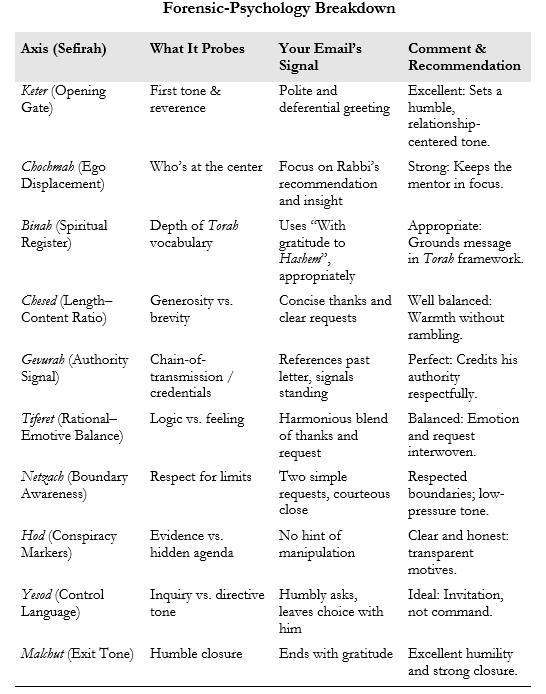
Even our simplest messages mirror the Torah’s perfect architecture — when we honor structure, every word carries its own sanctity.
Final Thoughts
This diagnostic system is not merely a tool for communication analysis. It is a window into the soul’s architecture — how inner states become visible through language, structure, and tone. Each message sent into the world reveals not only what is said, but from where it is said: a point of origin within the nefesh.
By tracing these signals across ten sefirotic axes and studying real-world expressions through case examples, we begin to see the contours of spiritual posture — alignment, distortion, or aspiration. The framework honors Torah categories, preserves halachic boundaries, and elevates perception beyond personal reaction toward soul-discernment.
But discernment is not judgment.
The goal is not to classify others, but to refine ourselves. To learn how to listen as the Torah listens: with form, with boundaries, and with compassion. May this work serve that listening. May it illuminate the hidden structure within speech, and draw us closer to the One Who spoke and the world came into being.
לעשות רצונך אלה”י חפצתי ותורתך בתוך מעי
“To do Your will, my G-d, is my desire — and Your Torah is deep within me”
— Tehillim 40:9
If this exploration resonated with you, consider subscribing below or writing to share your thoughts. Tehomia exists for such alignments.
Rabbi Avraham Chachamovits
Version 1.0 • Sivan 5785 / June 2025
 TEHOMIA