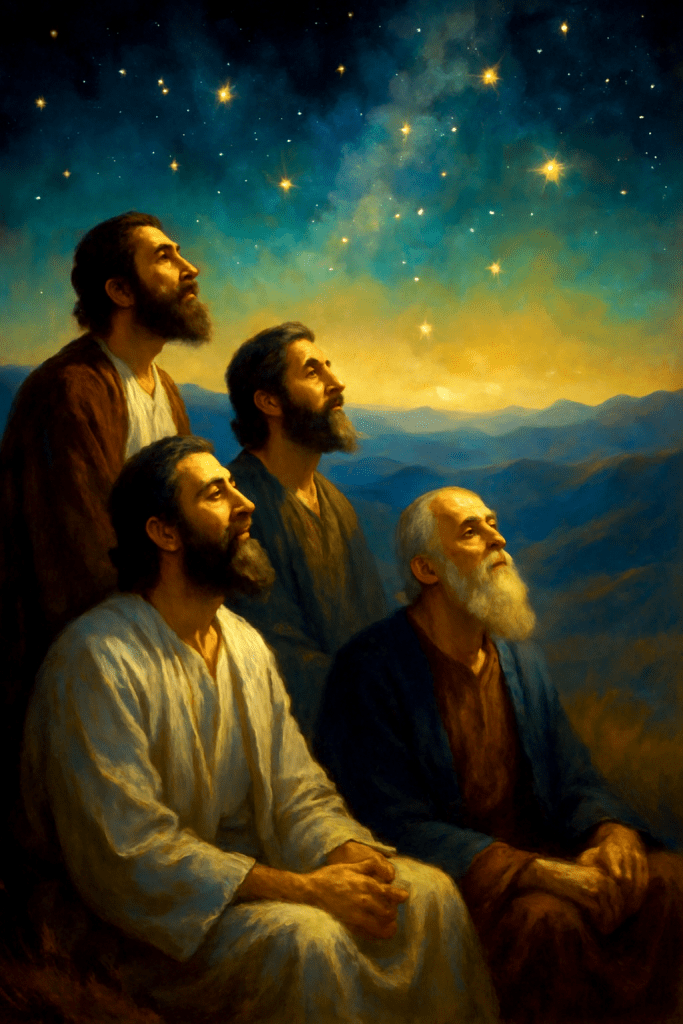
Holy vision reached where the body had not
Scientific Layer
Anomalous Cognition and Remote Viewing
In secular terminology, “remote viewing” is categorized under the broader field of anomalous cognition — a class of mental phenomena wherein a person claims to perceive information without the use of the known senses. This phenomenon is grouped under extrasensory perception (ESP), alongside psychokinesis, the purported ability to affect physical objects without direct physical contact. Remote viewing itself is sometimes called telesthesia or traveling clairvoyance.
Further subdivisions exist in parapsychological models:
– Telepathy refers to direct mental transmission from another person
– Clairvoyance describes perception without any identifiable source
– Retrocognition involves mental access to past events
– Precognition is the perception of events before they occur
Despite these classifications, parapsychology is widely dismissed by the scientific establishment. In 1988, the U.S. National Research Council concluded: “The committee finds no scientific justification from research conducted over a period of 130 years for the existence of parapsychological phenomena”. Modern academic literature typically explains instances of so-called clairvoyance through confirmation bias, expectancy effects, hallucination, sensory leakage, or statistical misjudgment.
Nevertheless, the Torah presents a radically different framework. Remote perception is not treated as a marginal anomaly but as a divinely enabled mode of consciousness, selectively granted for covenantal and sacred purposes. The miracle of kefitzat ha-derech — the contraction of space — is one such example. But subtler expressions of the same principle operate beneath overt miracle — conscious perception that spans space without ordinary sensory means.
Soul Dynamics
Mental Perception Across Distance in Torah
The case of Ya’akov Avinu introduces the template.
ויצא יעקב מבאר שבע וילך חרנה ויפגע במקום וילן שם “And Ya’akov went out from Be’er Sheva and went toward Charan. And he encountered the place and spent the night there” (Bereshit 28:10).
This juxtaposition raises a classic problem. If Ya’akov had reached Charan, how could he then “encounter the place” — Beit El — and sleep there afterward?
According to the Sages, Ya’akov reached Charan, then regretted not having prayed where his fathers had. Upon turning back, the earth miraculously contracted and he arrived instantly at Beit El. But a more subtle possibility exists: that Ya’akov, while still in Charan, remotely perceived the sanctity of Beit El and directed his prayer toward it with full mental presence.
The phrase ויפגע במקום “He encountered the place” encodes this possibility through intricate numerical construction:
– is the same gematria of שלהבת shalhevet “flame/blaze” (737)
– And with the added kolel, it is also the gematria of תשלח “send”
– and a tzeruf of חשמל chashmal (378)
– Its mispar ne’elam plus kolel equals 750 — the gematria albam of וירא את-המקום מרחק “And [Avraham] saw the place from afar” (Bereshit 22:4).
These connections suggest that Ya’akov’s act of encountering “the place” was not purely geographical but perceptual — a remote vision of the sacred site his fathers had sanctified.
Structural Echo
Seeing from Afar and Acting with Precision
The same structure appears in the story of Avraham’s journey to Mount Moriah.
ויקח אברהם את-עצי העלה וישם על-יצחק בנו ויקח בידו את-האש ואת-המאכלת וילכו שניהם יחדו “And Avraham took the wood of the burnt offering and laid it upon Yitzchak his son; and he took the fire in his hand, and a knife; and they went both of them together” (Bereshit 22:6).
This occurs before he has arrived at the location of the offering. Why would he carry heavy supplies up a mountain, instead of gathering them later? The answer lies in vision: Avraham had seen the area in advance and recognized its barrenness. He brought what he needed because he knew — through remote viewing — that there would be no trees to supply wood for the altar.
This insight is further confirmed through exact numerical correspondence. The phrase ויבאו אל-המקום “And they came to the place” (Bereshit 22:9), with 12 letters and 2 words — 14 units total. When processed via gematria albam using this unit structure, it yields 737 — identical to the gematria of ויפגע במקום.
Both Avraham and Ya’akov thus “encountered the place” not simply by arriving at it, but through a kind of remote presence that preceded and shaped their physical action. In both cases, Torah records the moment of arrival only after the necessary preparations had already been made.
Prophetic Architecture
Combined Modalities of Holy Cognition
The case of Iyov’s friends adds another dimension. The verse says:
וישמעו שלשת רעי איוב “And the three friends of Iyov heard” (Iyov 2:11).
But the reshei tevot of this phrase — ושרא — can be permuted to שראו “who saw”, implying not just auditory reception but remote visual perception of Iyov’s suffering.
Further, the gematria of this verse is 1761, the exact value of the verse:
ויאמר יהו״ה ראה ראיתי את־עני עמי “And Hashem said: I have indeed seen the suffering of My people” (Shemot 3:7).
The symmetry implies a Torah-sanctioned category of perceptual empathy — a witnessing from afar that is real, not symbolic. Iyov’s friends experienced both telepathy and remote seeing, and the Torah encodes this explicitly through permutation and numerical alignment.
Even more advanced is the case of Daniel and Nevuchadnetzar. Before Daniel could interpret the king’s dream, he had to retrieve the dream itself, which the king had forgotten. This required Daniel not merely to see remotely, but to access the contents of another person’s mind — a form of divinely permitted cognitive infiltration. Only after this feat could he then offer interpretation.
Here we find a threefold structure:
- He retrieved a dream that had been forgotten
- He accessed the mind of another
- He interpreted its meaning through divine permission
This was not self-willed psychic probing, but a sacred grant of perception for the purpose of restoring truth and orientation to a bewildered monarch.
Epilogue
Remote Perception as Covenant Function
Across the lives of the Patriarchs and the prophets, the Torah testifies to a class of perception that operates beyond distance, beyond language, beyond physical sequence. Ya’akov, Avraham, Iyov’s companions, and Daniel each encountered a place or reality they had not yet physically reached. But that encounter — whether through image, intuition, or inspired mental vision — was no less real. It shaped their choices and aligned their deeds with divine timing.
What modern science dismisses as anomaly or pseudoscience, Torah reveals as intentional design: a form of mental seeing granted only when holiness requires it. These are not mythic flourishes or poetic licenses, but demonstrations of covenantal consciousness unfolding across dimensional layers of space and soul.
This essay does not promote psychic power, nor does it attempt to validate spiritual experiences through secular theory. Rather, it identifies a structured Torah architecture in which perception and place are joined through intention, mission, and alignment with the will of Hashem.
Space-bending cognition is not paranormal but normal for the kadosh.
If this exploration resonated with you, consider subscribing below or writing to share your thoughts. Tehomia exists for such alignments.
Rabbi Avraham Chachamovits
Version 1.0 • Sivan 5785 / June 2025
© 2025 Avraham Chachamovits. Licensed under CC BY 4.0
📚 Source
This page is based on content from: Chachamovits, A. (2022). Avraham BaMidbar – Kabbalistic Writings, pp. 503-506.
Available from SeforimCenter.com
 TEHOMIA